

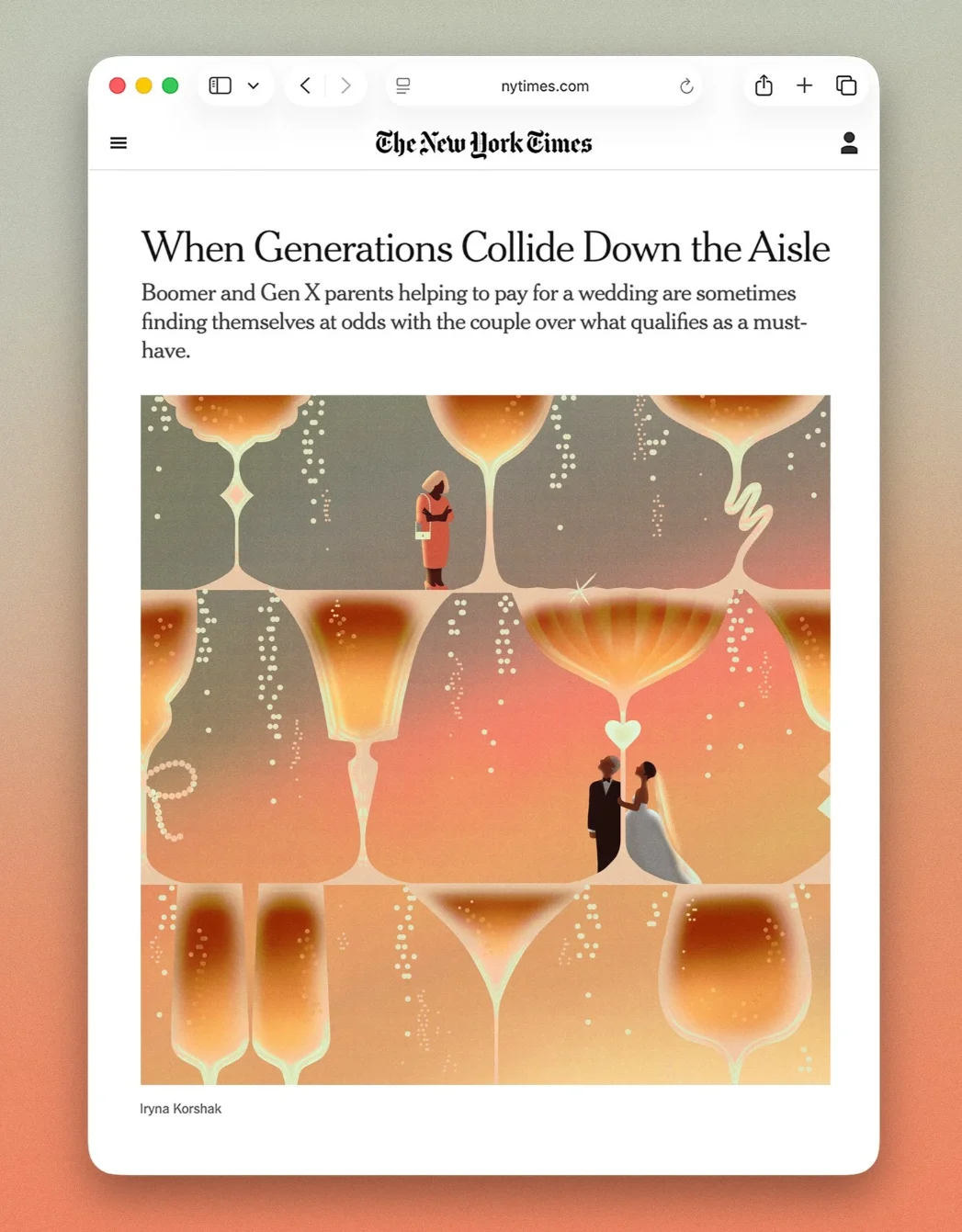
The intricate dynamics of wedding planning, particularly the friction between a couple’s desire for personalized celebrations and parents’ inclination towards "timeless" traditions, recently garnered national attention through a significant piece published by The New York Times. This article delved into the evolving landscape of matrimonial rites, highlighting the deep-seated intergenerational conflicts that often arise when financial contributions meet differing visions for a momentous life event. Central to this discussion was Offbeat Wed, a pioneering platform in the wedding industry, whose founder was extensively quoted, underscoring its two decades of unparalleled insight into these very dynamics.
The New York Times Spotlight on Generational Divides
Reporter Tammy LaGorce, in her New York Times article published this week, meticulously explored the burgeoning disagreements between engaged couples seeking unique, reflective celebrations and their parents, who often bear a substantial portion of the wedding costs and harbor expectations for more conventional, grand affairs. The piece brought to the forefront a conflict that, while seemingly about aesthetics or guest lists, often masks deeper power struggles and differing generational values regarding tradition, personal expression, and financial autonomy.
The inclusion of Offbeat Wed’s founder as a primary expert witness in the Times article was no coincidence. For nearly two decades, Offbeat Wed has served as a critical observer and facilitator of discussions surrounding non-traditional weddings, witnessing firsthand the evolution of these intergenerational clashes. From Gen X couples navigating parental expectations in their twenties to now seeing members of that same generation grappling with similar issues as parents of Millennials and Gen Z, the platform has compiled a unique, long-term perspective. The article not only featured insights from Offbeat Wed’s leadership but also spotlighted Ohio wedding planner Emily Berg, a distinguished member of the Offbeat Wed vendor community, further cementing the platform’s role as a vital resource for both journalistic inquiry and industry expertise. This marks the second instance this year where Offbeat Wed’s vendor members have been quoted in The New York Times, signaling a growing recognition of their unique perspectives on modern wedding trends and challenges.
The Undercurrents of Conflict: Beyond Table Settings
While The New York Times piece adeptly captured the surface manifestations of these conflicts, Offbeat Wed’s analysis suggests that the true roots lie in deeper structural issues within the wedding industrial complex and evolving family dynamics. These underlying factors, often overlooked, provide crucial context for understanding why disagreements over venue choices or floral arrangements can escalate into significant familial strife.
The Wedding Industrial Complex: Marketing to Parental Expectations
A critical, yet often unstated, facet of the modern wedding industry is its historical and ongoing marketing strategy. Contrary to popular belief, the mainstream wedding industry has not, for decades, primarily targeted the engaged couple. Instead, its messaging has been meticulously crafted to appeal to their parents. This strategic focus capitalizes on the fact that parents often contribute significantly, if not entirely, to wedding expenses, thereby becoming primary decision-makers or influential stakeholders.
Parents, particularly those from older generations like Baby Boomers and early Gen X, grew up in an era with a different relationship to media authority. Information from bridal magazines, established wedding planners, and grand venues was often internalized as indisputable fact regarding what a "proper" wedding should entail. When industry professionals, whether a venue-mandated coordinator or a traditional florist, present certain elements as essential or "non-negotiable," these messages resonate deeply with a generation conditioned to trust such authoritative pronouncements. This contrasts sharply with younger generations (Millennials and Gen Z), who, having grown up immersed in a vast, often contradictory, landscape of internet opinions and social media trends, approach such pronouncements with greater skepticism and a stronger desire for personalized choices.
This generational disparity in media consumption and trust creates a fertile ground for conflict. What appears to be a dispute over table settings, guest lists, or dress codes is often, at its core, parents enforcing commercially driven traditions that the couple themselves do not recognize as mandatory. Offbeat Wed’s founder has previously described some of this mainstream wedding marketing as "predatory," arguing that it exploits parental emotional investment and financial generosity by instilling a sense of obligation towards elaborate, often costly, and conventionally dictated celebrations. The implication is that the industry has skillfully cultivated a narrative of what a wedding "must" be, primarily for those footing the bill, thereby inadvertently fueling intergenerational tension.
Financial Leverage and the Evolution of Wedding Costs
The financial aspect of weddings cannot be overstated in this context. The average cost of a wedding in the United States has steadily climbed over the past decades, with recent figures often placing it upwards of $30,000, and significantly higher in major metropolitan areas. This substantial financial outlay often necessitates parental contribution, which, while generous, can come with an unspoken (or explicit) expectation of influence over the planning process.

Data from various industry reports indicates that parents contribute to a significant percentage of wedding costs, with some surveys suggesting that parents contribute to or cover more than 50% of the expenses for a substantial portion of weddings. This financial leverage creates a complex dynamic where parents, in their effort to provide a memorable event for their children, often project their own long-held visions and societal expectations onto the celebration. For couples, particularly those who may be financially independent in other aspects of their lives, navigating this parental generosity while striving for personal expression becomes a delicate balancing act. The adage "he who pays the piper calls the tune" becomes acutely relevant in these high-stakes negotiations, where a gift of financial support can transform into a subtle, or not-so-subtle, demand for traditional conformity.
The Wedding as a "Petri Dish" of Family Dynamics
Offbeat Wed has long characterized weddings as a "petri dish of family dynamics." This powerful analogy highlights how all pre-existing, often simmering, family issues — ranging from financial philosophy and communication styles to the treatment of adult children and the navigation of disagreement — become intensely concentrated and amplified within the context of wedding planning. The pressure of a deadline, a significant budget, an extensive guest list, and the emotional weight of a life-altering event turn up everyone’s feelings "LOUD," as the platform’s founder aptly puts it.
For many couples in their twenties and early thirties, wedding planning represents the first truly high-stakes negotiation they undertake with their parents as fellow adults. This is often a novel experience, laden with significant financial and emotional implications. Unfortunately, many families lack the established communication infrastructure or conflict resolution skills necessary to navigate such complex conversations effectively. Consequently, disagreements can quickly escalate, leading to predictable patterns of conflict that, to an experienced observer, reveal themselves as deeper power negotiations rather than mere taste differences.
Understanding this phenomenon is not just crucial for cultural context but also offers practical guidance for non-traditional wedding vendors. When a couple expresses stress or frustration over parental conflict, it is rarely just about a specific decorative choice. Instead, it signals a fundamental power negotiation that the family is experiencing, often for the first time, with the wedding serving as the arena. Recognizing this distinction allows vendors to listen more empathetically, ask more incisive questions, and offer more meaningful support, potentially helping couples navigate these familial waters more effectively.
The Broader Societal Shift and Why Offbeat Wed Matters to the Media
The consistent interest from The New York Times in platforms like Offbeat Wed speaks to a broader societal shift in how weddings are perceived and celebrated. Over the past few decades, marriage rates have seen a decline, the average age of first marriage has risen, and cohabitation has become more common. These demographic shifts are coupled with a cultural evolution where individual expression and authentic experiences are increasingly prioritized over rigid adherence to tradition.
The rise of the internet and social media platforms has also democratized wedding inspiration, moving away from the curated, often homogenous, aesthetics promoted by traditional bridal magazines. Couples now have access to a vast array of ideas, from deeply personal ceremonies in unconventional locations to highly themed celebrations that reflect their unique identities. This explosion of options, while empowering, also contributes to the divergence of expectations between couples and their more tradition-bound parents.
Offbeat Wed, established in 2007, positioned itself early on as a counter-narrative to the mainstream wedding industry. It has consistently provided a platform for "offbeat" couples and vendors who champion individuality, diversity, and genuine self-expression in wedding celebrations. This long-standing commitment to nuanced thinking about weddings, coupled with its extensive archive of real-life experiences and expert analysis, makes it an invaluable resource for journalists covering the evolving landscape of relationships, family dynamics, and cultural trends. Reporters seeking a deeper, more informed perspective on modern wedding challenges, particularly the often-complex interplay of generations and finances, frequently turn to Offbeat Wed for its unique insights and its network of forward-thinking vendors. The platform’s ability to articulate the underlying structural issues and familial dynamics makes it a critical voice in understanding contemporary nuptial culture.
Implications for the Future of Weddings
The ongoing dialogue surrounding intergenerational wedding conflict underscores a larger cultural conversation about autonomy, tradition, and the role of family in significant life events. As younger generations continue to prioritize authenticity and personal meaning, and as the economic realities of weddings persist, these tensions are unlikely to abate.
For the wedding industry, this presents both challenges and opportunities. Vendors who can adapt their services to mediate these conflicts, empower couples, and navigate parental expectations with sensitivity are poised for success. Platforms like Offbeat Wed, by fostering a community of such understanding and adaptable professionals, play a crucial role in shaping a more inclusive and less conflict-ridden future for weddings. By openly discussing the "predatory" marketing tactics and the "petri dish" nature of family dynamics, Offbeat Wed not only informs but also advocates for a wedding experience that is truly reflective of the couple, rather than dictated by external pressures or outdated commercial narratives. The continued engagement of esteemed publications like The New York Times with Offbeat Wed’s perspective signifies the growing recognition that the narrative of weddings is far more complex and multifaceted than traditional portrayals suggest, demanding a more nuanced and empathetic approach from all involved.