For many, an inherited diamond is more than just a gemstone; it’s a tangible link to family history, a whisper of generations past. Whether received during a poignant moment of remembrance or presented with the joy of a new beginning, these stones carry immense sentimental value. Yet, the accompanying setting often fails to resonate with contemporary aesthetics or personal style, prompting a common question: what does it truly cost to transform this cherished relic into a wearable symbol of one’s own narrative? This article aims to provide a clear, data-backed exploration of heirloom diamond resetting, moving beyond vague estimations to offer a transparent understanding of the process, costs, and critical considerations.
The fundamental shift in perspective for anyone considering a reset is recognizing that the most significant financial component of an engagement ring – the diamond itself – is already secured. The endeavor, therefore, is not to purchase a new ring, but to commission a new setting, tailor-made to honor both the stone’s heritage and the wearer’s individuality. This guide delves into the actual cost ranges, the key factors influencing pricing, essential pre-reset inspections, and candid assessments of when resetting may or may not be the optimal path.
Understanding the Financial Landscape: What an Heirloom Diamond Reset Actually Costs
Dispelling the ambiguity often surrounding this topic, a professional heirloom diamond reset typically ranges between $500 and $2,500. This widely cited range, supported by industry sources like The Knot, encompasses a spectrum of services from basic stone transfers to more intricate semi-custom designs. At the most economical end, a straightforward stone swap into a pre-fabricated, ready-made setting can be as low as $80 to $250, with an average around $300, as noted by Scott’s Custom Jewelers. Some designers streamline this further; for instance, Melanie Casey charges a standard $500 to integrate a client’s stone into any of her existing settings, offering predictability in pricing for specific design aesthetics.
However, the landscape shifts considerably for fully custom work. When a jeweler embarks on designing a unique, one-of-a-kind setting from its inception, crafted precisely around the dimensions and characteristics of a specific heirloom stone, project costs typically commence around $5,500 and can escalate significantly based on complexity and materials.
Leading custom jewelry studios, such as Kinn, outline their "Repurpose" projects starting at approximately $2,500. This initial figure usually covers a more direct design approach with limited customization and a relatively simple setting. Kinn’s experience indicates that most clients often choose to invest more as they progress through the design process, recognizing the vast potential for personalization. This often translates into using a greater quantity of precious metal, incorporating additional accent stones, adjusting design proportions, or developing an entirely bespoke creation. The upper limit for such projects is largely fluid, dictated by the client’s design aspirations, with the primary cost drivers identified as gold weight, the inclusion of supplementary stones, and the overall level of design customization and labor intensity.
Beyond the Metal: Deconstructing the Reset Price
The quoted price for a diamond reset extends far beyond the mere cost of the new metal. It encapsulates a comprehensive suite of professional services and guarantees. This includes the delicate and skilled labor of safely extracting a stone from its often decades-old, potentially fragile setting, the cost of the new setting itself (or the intricate design and casting process for a custom piece), the market value of the precious metal by weight, the specialized work of securely setting the stone, and crucially, the jeweler’s implicit guarantee that your irreplaceable diamond will endure the entire process without damage. This last, often invisible, component on any quote represents the highest value – the peace of mind that comes with entrusting a cherished family heirloom to expert hands.
The variability in quotes received from different jewelers for the same stone underscores the diverse approaches available. One jeweler might propose a simple swap into a readily available catalog setting, another might suggest modifying a semi-custom design, while a third could offer a completely bespoke creation based on a unique sketch. Each approach constitutes a distinct project, justifying disparate pricing. Understanding the core elements that drive an engagement ring’s price empowers consumers to navigate these conversations effectively, ensuring they are comparing equivalent services and designs.
The Four Pillars of Pricing: What Drives the Cost of a Reset
Once these four fundamental factors are understood, deciphering any jeweler’s quote becomes a transparent exercise, revealing precisely where the investment is allocated. According to experts at Kinn, the predominant factors influencing cost are the quantity of gold required, the labor involved in crafting the piece, and the inherent complexity of the new design. A significant portion of this intricate work commences even before the physical creation of the new piece. This initial phase involves the meticulous unmounting of the existing stone, a thorough inspection, and retesting against any provided appraisals to precisely confirm its specifications and condition.
From this foundational understanding, the new design is meticulously constructed around the exact dimensions and proportions of the client’s specific stone. For a truly bespoke piece, Kinn elaborates that this can involve an iterative design development process, generating detailed Computer-Aided Design (CAD) renderings, 3D printing a wax model for physical review and fit testing, and making necessary adjustments before the final piece is cast in gold. These steps are inherently personalized, meaning the labor and complexity can fluctuate considerably from one heirloom stone to another, directly impacting the final cost.
-
Choice of Metal and Weight: The type of metal (e.g., 10k, 14k, 18k gold in yellow, white, or rose; platinum) and the overall weight required for the setting are primary cost determinants. Platinum, being denser and rarer, is generally more expensive than gold. Higher karat gold (18k vs. 14k) also commands a higher price. A more substantial, robust setting or one with intricate design elements will naturally require more metal, increasing the material cost. For instance, a delicate solitaire setting will use significantly less metal than a wide band with pave detailing.
-
Design Complexity and Fabrication Method: The intricacy of the chosen design plays a crucial role. A simple solitaire setting is less labor-intensive than a halo setting with micro-pave diamonds, a vintage-inspired filigree design, or a highly sculptural custom piece. Hand-fabricated designs, which involve a jeweler meticulously shaping metal from scratch, are typically more expensive than those produced via CAD design and casting, though both methods require significant skill. Complex designs necessitate more design time, more detailed CAD work, multiple wax models, and specialized finishing techniques.
-
Inclusion of Additional Stones: Opting to incorporate accent diamonds or colored gemstones into the new setting will add to the overall cost. This includes the price of the additional stones themselves, as well as the labor involved in precisely setting each one. The size, quality (color, clarity), and quantity of these supplementary stones can substantially impact the final price. For example, a hidden halo or an intricate pave band will significantly increase costs compared to a plain metal band.
-
Jeweler’s Expertise, Reputation, and Location: The jeweler’s experience, their specialization in heirloom or custom work, and their overall reputation directly influence their pricing structure. Highly skilled artisans with a proven track record for delicate heirloom work often command higher fees, reflecting their specialized knowledge, precision, and the insurance coverage they maintain. Boutique studios in major metropolitan areas may have higher overheads, which can translate into higher labor rates compared to jewelers in smaller towns. Their ability to handle unique challenges presented by older stones or intricate designs is a premium service.
The Indispensable First Step: Stone Inspection Before Design
This critical warning precedes any discussion of aesthetics or design, underscoring its paramount importance. An heirloom diamond that has resided in its original setting for many decades may conceal latent imperfections. Chips along the girdle (the diamond’s widest edge) or internal fractures might only become apparent once a professional jeweler carefully extracts the stone, a point emphasized by WeddingWire in its comprehensive resetting guide.
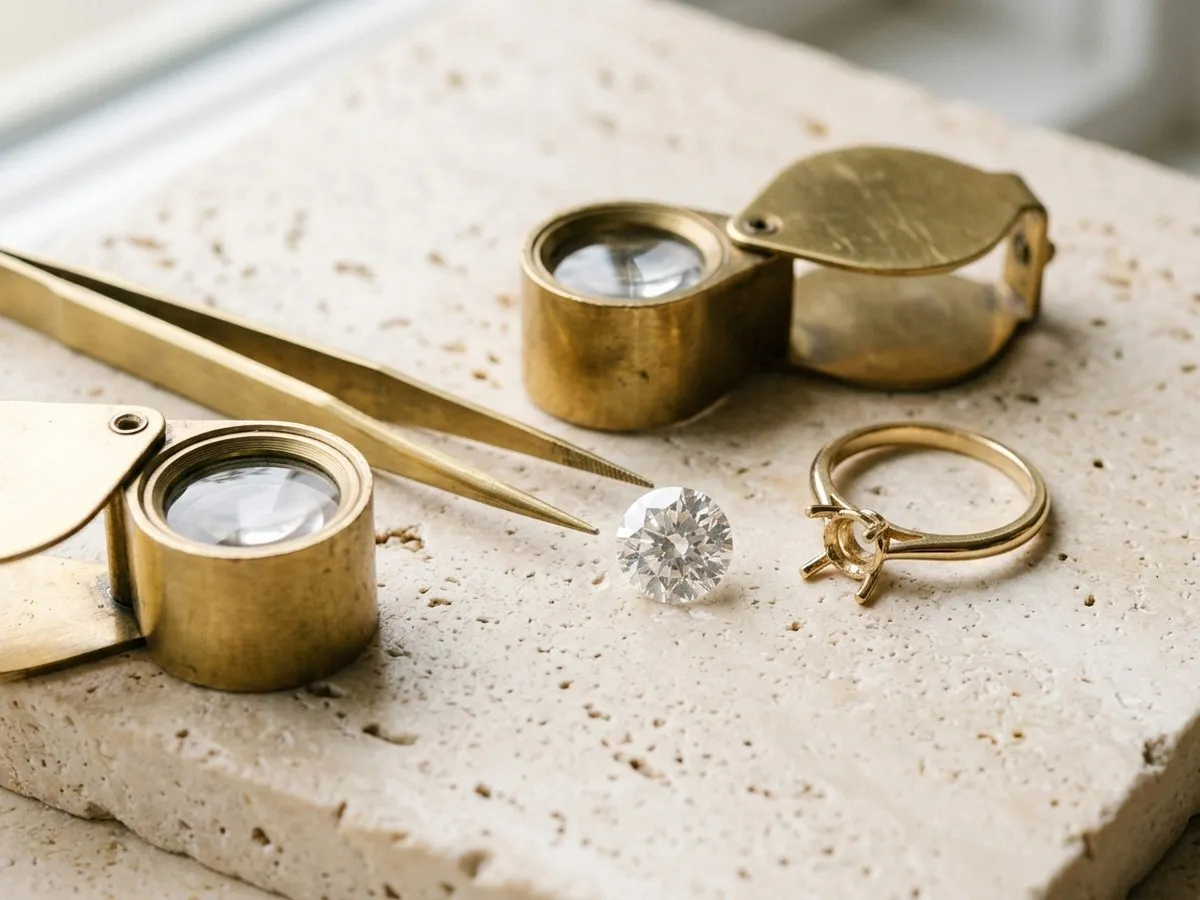
Therefore, commissioning any design work without an initial, thorough inspection of the stone is a significant oversight. A qualified jeweler will meticulously examine the diamond under high magnification, assessing its structural integrity and determining its ability to safely withstand the removal and resetting process. They will also identify any pre-existing damage that might necessitate repair or influence the choice of a new setting. Discovering such issues after a new setting has been ordered can transform a projected $600 project into a $2,000 unforeseen expense. Understanding what a jeweler evaluates, beyond the conventional "four Cs," provides valuable insight into this crucial assessment.
Callout: Inspection First, Always. Before any design conversation, have the stone examined under magnification and get the findings in writing. It protects the stone, the budget, and the timeline.
Reset or Buy New? A Candid Financial and Emotional Analysis
It is imperative to address a common misconception: an heirloom diamond reset is not automatically the most economical choice. To pretend otherwise would be a disservice to informed decision-making. A pragmatic comparison requires an honest assessment of two distinct paths:
- Heirloom Reset: This column includes the cost of unmounting, stone inspection (if charged separately), the new setting (metal, design, labor, additional stones if chosen), and post-reset appraisal.
- New Ring Purchase: This column includes the full cost of a new diamond (natural or lab-grown) plus the new setting.
While the "free" diamond of an heirloom piece eliminates the most significant expense of a new ring, a custom-designed, high-quality setting for an heirloom can still represent a substantial investment, sometimes rivaling the cost of a new, simpler ring featuring a lab-grown diamond.
So, why choose to reset? The answer transcends mere cost; it lies in the distinction between "cheapest" and "wisest." The philosophy often guiding such decisions is not about minimizing expenditure but about maximizing value and meaning. Investing in a new setting for a stone that already holds generations of family history is an incredibly savvy allocation of resources. While a newly acquired lab-grown diamond might perfectly match your grandmother’s diamond in terms of the four Cs (carat, cut, color, clarity), it unequivocally cannot replicate the "fifth C": the compelling story it carries. The investment in a reset is not merely for a piece of jewelry; it is an investment in wearing that narrative, that legacy, every day of a marriage. This conscious choice to preserve and personalize a family artifact imbues it with profound, enduring value.
This is precisely where the expertise of a specialized maker becomes paramount. Kinn, a fine jewelry studio renowned for handcrafting 14k solid gold pieces in Los Angeles and New York, has built its "Custom Repurpose" service on this very principle. Their ethos, encapsulated by "then, now, always," focuses on transforming family stones into contemporary settings designed for daily wear. Their engagement settings, starting around $2,000, come with a two-year warranty and complimentary resizing. Kinn openly states it is not the budget-basement option, but rather a premium choice for those who recognize that a stone of such significance warrants a setting meticulously crafted around its unique character – which is the very essence of a meaningful reset.
Expanding Horizons: Beyond the Engagement Ring
The beauty of an heirloom stone lies in its versatility. Should an engagement ring not be the desired outcome, perhaps due to personal preference or the stone’s characteristics, a wealth of other lovely options emerge:
- Pendant Necklace: A timeless and elegant choice, allowing the diamond to rest close to the heart. This option is particularly suitable for stones that might be too fragile for daily wear on a finger or those that are unusually shaped. Various chain lengths and styles, from delicate chains to more robust designs, can be chosen to complement the stone.
- Right-Hand Ring/Cocktail Ring: For those who desire a statement piece separate from an engagement ring, a bold right-hand ring allows the heirloom to be showcased as a fashion accessory or a symbol of personal achievement. These designs often incorporate more intricate settings or additional stones.
- Earrings (if two stones): If you are fortunate enough to inherit two matching (or complementary) stones, transforming them into elegant stud or drop earrings creates a harmonious pair, ideal for daily wear or special occasions.
- Bracelet Charm/Centerpiece: Integrating the diamond into a bracelet, either as a singular charm or as the focal point of a larger design, offers another way to keep the stone close and visible.
- Cufflinks: For a unique and sophisticated masculine touch, a smaller heirloom diamond can be set into custom cufflinks, creating a distinctive accessory for formal wear.
- Tie Tack/Lapel Pin: Similar to cufflinks, these offer a subtle yet elegant way to incorporate the diamond into menswear, adding a touch of personal history to professional or formal attire.
- Brooch: A larger or unusually shaped diamond can be beautifully set into a custom brooch, offering a versatile piece that can adorn clothing, scarves, or even hats.
Should the reset lean towards a custom, made-to-order piece, exploring guides on unique engagement rings can provide valuable insights into design routes. Furthermore, given the often classic appeal of heirloom stones, a deep dive into vintage-inspired settings is frequently a logical and aesthetically pleasing starting point for design exploration.
The Timeline: Planning Your Heirloom Reset Project
It is important to manage expectations regarding the timeline for an heirloom reset. Unlike purchasing an off-the-shelf ring, a bespoke or semi-custom design must be meticulously crafted around an existing stone. Clients should anticipate the entire process, from the initial consultation to the finished piece, taking several months, with more intricate designs naturally requiring longer.
According to the team at Kinn, their bespoke "Repurpose" projects generally require 6 to 8 weeks for production once the design has been fully finalized. However, this production phase is preceded by a critical evaluation and design stage. This preliminary work includes the careful unmounting and inspection of the stones, verification of their precise specifications, the iterative development of the design to precisely accommodate the stone’s exact dimensions, the creation of CAD renderings, and the printing and testing of wax models, followed by any necessary adjustments.
Kinn emphasizes that, unlike designing around a stone they source themselves, a repurpose project necessitates working within the constraints and unique characteristics of an existing heirloom. The design process must adapt to the stone, rather than the stone adapting to a pre-conceived design. This fundamental difference underscores the need for a specific, methodical process behind each bespoke piece.
Clients should work backward from any significant dates, such as a planned proposal or wedding. For a holiday proposal, for instance, the heirloom stone should ideally be in the jeweler’s hands by early fall to allow ample time. For a wedding-day piece, factoring in a generous buffer beyond the estimated completion date is prudent, as heirloom work is precisely the kind of project that should never be rushed.
Vetting Your Jeweler: Essential Questions Before Entrusting Your Stone
Before entrusting a jeweler with your irreplaceable heirloom, a thorough consultation is crucial. The following questions serve as a vital checklist to ensure transparency, expertise, and peace of mind:
- What is your experience specifically with heirloom or antique stones? This gauges their familiarity with older settings and potentially fragile stones.
- What is your process for unmounting and inspecting the stone? Look for detailed explanations of their careful handling and assessment procedures.
- What is your liability policy in case the stone is damaged or lost during the process? This is non-negotiable; a reputable jeweler will have clear insurance policies and guarantees.
- Will the finished piece come with an independent appraisal? A new appraisal is essential for insurance purposes, reflecting the stone’s value in its new setting.
- What is the warranty on the new setting? Understand the coverage for craftsmanship and material defects.
- Can you provide references or examples of similar heirloom reset projects you’ve completed? Visual evidence and client testimonials offer valuable assurance.
- What is the estimated timeline and payment schedule for my specific project? Clear communication on these points prevents misunderstandings.
A truly professional and trustworthy jeweler will answer all seven of these questions without hesitation, providing clear and confident responses. Any equivocation, particularly regarding liability and insurance, should be a significant red flag, prompting you to continue your search.
When to Preserve: Understanding When Not to Reset
A responsible guide to heirloom resetting must include candid advice on situations where altering the piece might be ill-advised. There are legitimate reasons to choose preservation over transformation:
- Fragile Stone Condition: Some diamonds, particularly those with significant internal inclusions (feathers, fissures) or pre-existing chips, may be too fragile to safely withstand the stress of unmounting and resetting. Other gemstones, like opals or certain emeralds, are inherently more delicate and might not be suitable for the rigors of a new ring setting, which is exposed to daily impacts.
- Historical or Artistic Value of the Original Setting: The original setting itself might possess significant historical, artistic, or intrinsic value, perhaps representing a rare design period or a master craftsman’s work. In such cases, disassembling the piece would diminish its overall worth and historical integrity.
- Sentimental Attachment to the Entire Original Piece: For some, the sentimental value extends beyond the stone to the original setting as a whole, representing a direct connection to the giver or a specific era. Altering it, even for modernization, might feel like a loss rather than an enhancement.
- The Stone’s Unsuitability for Ring Wear: As noted by Kinn, some stones are simply not ideal for the daily wear and tear of a ring. A more delicate stone might be far safer and last longer as a pendant, where it is exposed to significantly less impact and abrasion.
- Minimal Impact of a Full Reset: Sometimes, clients enter the process believing a complete overhaul is necessary when a smaller, more focused intervention would suffice. Preserving the original design while simply changing the chain, rebuilding a worn setting, or adding a personalized engraving can achieve the desired revitalization without a full reset. Kinn highlights that "repurposing" doesn’t always necessitate starting from scratch.
In these instances, the alternative of restoration becomes a viable and often more appropriate path. Restoration focuses on repairing, cleaning, and reinforcing the original setting to bring it back to its former glory, preserving its authenticity and integrity while ensuring its wearability.
Beyond individual choices, the decision to reset an heirloom aligns with broader ethical and sustainable practices. The use of recycled and reclaimed stones, along with repurposing existing precious metals, makes heirloom resetting one of the most environmentally conscious choices in fine jewelry. By extending the life cycle of existing materials, it reduces the demand for new mining and processing, allowing clients to feel good about their contribution to sustainable luxury.
Your Next Steps: A Practical Recap
As you embark on this journey, carry these key takeaways into your jeweler’s studio: You already possess the most valuable component – the diamond. Your focus is on selecting and crafting a setting. Anticipate a general cost range of $500 to $2,500 for most professional heirloom diamond resets, but be prepared for higher costs for bespoke work. Understand the four primary levers that influence this number: metal choice and weight, design complexity, additional stones, and the jeweler’s expertise. Crucially, prioritize a comprehensive inspection of your stone before committing to any design. And, if a candid assessment reveals that preserving the original piece untouched is the wisest course of action, that too is a savvy and meaningful decision.
Whatever path you ultimately choose, you are approaching this process thoughtfully, on your own terms, and directing your investment toward what truly holds meaning. An heirloom ring has already covered the most expensive part for you.
One final, often overlooked, but critically important step: once your beautifully transformed heirloom ring is securely on your hand, ensure it is properly insured. A piece so irreplaceable, rich with history and personal significance, deserves comprehensive paperwork to match its profound value.