


The landscape of engagement ring shopping is undergoing a significant transformation, driven by the increasing accessibility and affordability of lab-grown diamonds. Once a niche alternative, these scientifically identical gemstones are now enabling couples to acquire substantial, high-quality rings at price points previously unimaginable for comparable natural stones. A recent analysis, conducted in partnership with jeweler Ritani, highlights how budgets of $1,500, $3,000, and $5,000 can now yield impressive lab-grown diamond engagement rings, shifting consumer expectations and empowering more personalized purchasing decisions.
The Rise of Lab-Grown Diamonds: A Scientific and Economic Overview
At the heart of this market shift is the nature of lab-grown diamonds themselves. Far from imitations, these are genuine diamonds, sharing the exact same chemical, physical, and optical properties as their mined counterparts. Formed under controlled laboratory conditions that replicate the intense heat and pressure deep within the Earth, they consist of pure carbon arranged in a crystalline lattice, exhibiting identical hardness and brilliance. This fundamental identity is a critical distinction from diamond simulants like cubic zirconia or moissanite, which merely look like diamonds but differ in composition.
The grading of lab-grown diamonds mirrors that of natural diamonds, utilizing the established 4Cs framework: cut, color, clarity, and carat weight. Reputable jewelers, including Ritani, provide independent certification, typically from institutions like the International Gemological Institute (IGI), ensuring transparency and verifiable quality for consumers. This certification details the diamond’s specific characteristics, allowing buyers to make informed comparisons.
Economically, the appeal of lab-grown diamonds is profoundly disruptive. Industry data indicates that lab-grown diamonds are typically priced between 50 to 80 percent less than natural diamonds of comparable quality and size. This substantial price differential is primarily due to controlled production environments, shorter supply chains, and the absence of the significant overheads associated with large-scale mining operations and complex global distribution networks. The rapid advancement in manufacturing technology, such as High-Pressure/High-Temperature (HPHT) and Chemical Vapor Deposition (CVD) methods, has also contributed to increased production efficiency and falling costs, making these stones more accessible than ever before.
Beyond price, lab-grown diamonds often appeal to consumers seeking ethically and environmentally conscious options. Their production process avoids the social and environmental impacts sometimes associated with diamond mining, offering a "conflict-free" guarantee and a smaller carbon footprint, a factor increasingly important to modern consumers.
Strategic Purchasing: Separating Diamond and Setting

A key insight for navigating the modern engagement ring market, particularly with lab-grown diamonds, is the practice of purchasing the center diamond and the ring setting separately. While seemingly an extra step, this method provides unparalleled control over the budget and final design. Many jewelers, including Ritani, structure their offerings this way, allowing customers to allocate funds precisely where they matter most to them.
The setting encompasses the metal band and the intricate details that secure the center stone, including prongs, bezels, or decorative elements. Its cost is determined by factors such as the chosen metal (e.g., 14kt or 18kt white, yellow, or rose gold, or platinum) and the complexity of the design. For example, a classic solitaire setting in 14kt white gold will generally be less expensive than a platinum setting with pave diamonds along the band or a hidden halo. By considering the setting and the diamond as two distinct budget components, couples can strategically adjust their spending. If a larger diamond is paramount, a simpler setting can be chosen. Conversely, if an intricate design is desired, a slightly smaller carat weight might be selected for the center stone. Ritani’s offerings, for instance, accommodate a wide range of center diamond sizes, from 0.15 carats to over 15 carats, ensuring flexibility across various setting styles. Furthermore, for settings that incorporate smaller accent diamonds, consumers often have the option to choose between lab-grown or natural accents, providing another opportunity for budget optimization.
Budget Analysis: What Different Price Points Yield
The analysis of engagement ring budgets at $1,500, $3,000, and $5,000 reveals a stark contrast to historical purchasing power, largely due to the lab-grown diamond market. The prices cited were accurate as of November 12, 2026, offering a snapshot of a dynamic market where individual diamond prices can fluctuate.
The $1,500 Tier: Redefining Entry-Level Luxury
For many years, a $1,500 budget for an engagement ring often meant compromising significantly on carat weight or quality, particularly with natural diamonds. However, the advent of lab-grown diamonds has dramatically altered this reality. This tier now allows for a substantial, high-quality center stone within a well-crafted, elegant setting.
A classic four-prong solitaire setting remains a popular choice at this price point. Its minimalist design not only keeps the setting cost low but also maximizes the visibility and brilliance of the center diamond. A 14kt gold setting, known for its durability and aesthetic appeal, typically represents the most budget-friendly metal option without sacrificing quality.
As an illustrative example, Ritani offered a 14kt white gold Teya round solitaire setting for $935 on the analysis date. Paired with a 1.50-carat ideal-cut round lab-grown diamond, certified by IGI with G color and VS1 clarity, the stone was priced at an astonishing $357. The total cost for this combination amounted to $1,292, leaving considerable room within the $1,500 budget for additional services like engraving or a comprehensive care plan. This particular example highlights a significant market trend: the cost of the lab-grown center stone can now be less than that of the setting, a phenomenon virtually unheard of in the natural diamond market. This allows couples to secure a visibly impressive diamond without financial strain.

The $3,000 Tier: Maximizing Impact and Quality
The $3,000 budget represents a popular middle ground, offering significant flexibility to prioritize specific features. At this level, couples can opt for a larger diamond, a superior cut grade, or a more elaborate setting, or a combination of these elements. The Teya round solitaire setting, costing $935 in 14kt white gold, still leaves approximately two-thirds of the budget for the center stone, demonstrating the efficiency of lab-grown diamonds.
The true surprise at this tier lies in the potential for exceptional value. Upgrading the Teya setting to platinum, a more durable and hypoallergenic metal, cost only $1,015 on the analysis date, a modest increase of $80 over the 14kt white gold option. Paired with a 3.04-carat ideal-cut round lab-grown diamond, boasting an F color and VS1 clarity (IGI certified), the stone was priced at $789. This combination resulted in a total cost of $1,804 for a three-carat platinum solitaire, coming in approximately $1,200 under the $3,000 budget. This significant surplus can be reallocated to other wedding expenses, a honeymoon, or simply added to savings, underscoring the extraordinary value proposition of lab-grown diamonds.
For those prioritizing brilliance, investing in an exceptional cut grade for a round diamond is highly recommended. A perfectly cut diamond can exhibit superior sparkle and often appear larger than a heavier stone with a lesser cut quality, maximizing visual impact.
The $5,000 Tier: Embracing Design and Premium Details
With a $5,000 budget, the focus often shifts from sheer carat weight to intricate design elements and premium materials, as substantial diamonds are already highly accessible at lower price points. This tier allows for the inclusion of sophisticated details that enhance the ring’s aesthetic appeal and uniqueness.
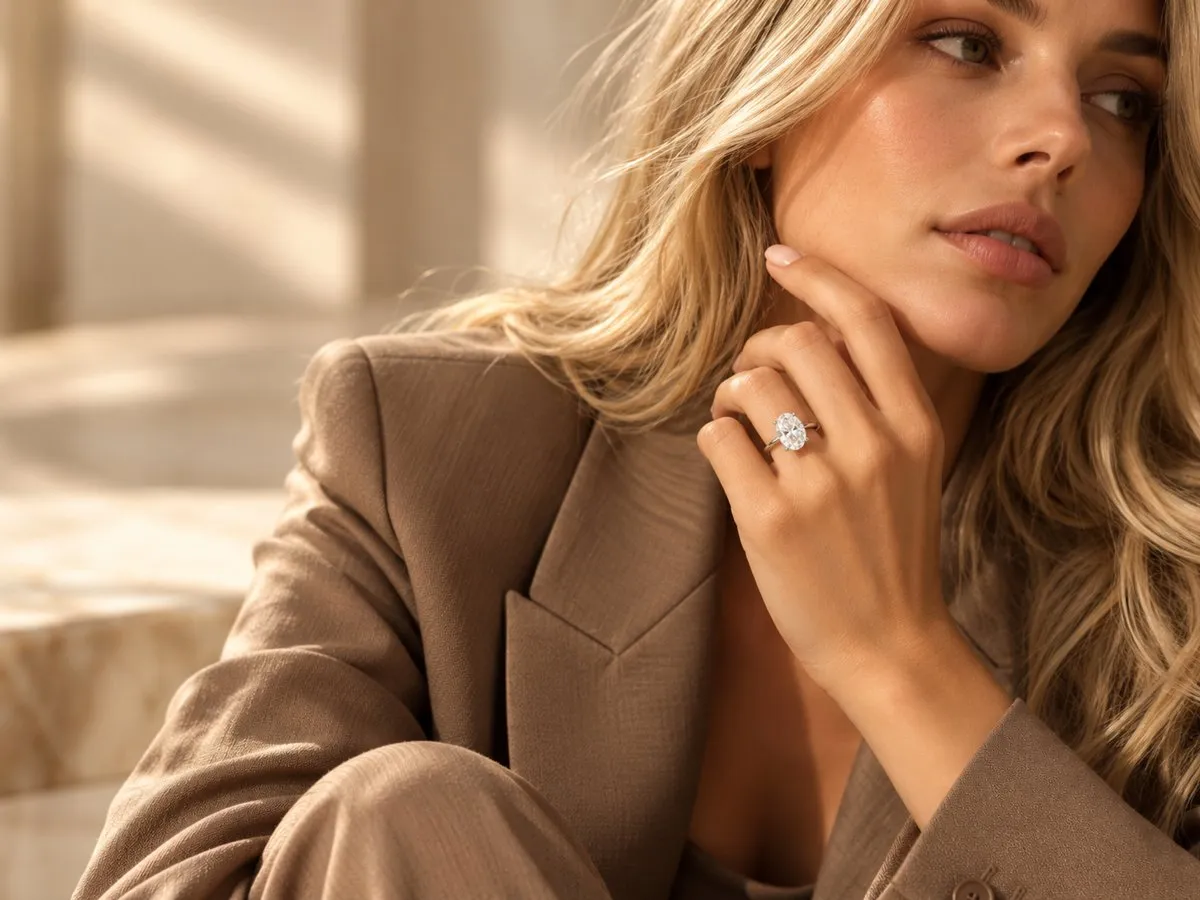
An excellent illustration is the Stella oval solitaire, which features a hidden halo—a delicate ring of small diamonds subtly tucked beneath the center stone. From above, the Stella maintains the clean, classic lines of a solitaire, while the side view reveals a surprising flash of extra sparkle. On November 12, 2026, the Stella setting was priced at $2,132 in 14kt white gold and $2,638 in platinum.
Combining the platinum Stella setting with a 3.10-carat oval lab-grown diamond (very good cut, F color, VS1 clarity, IGI certified), listed at $896, resulted in a total price of $3,534. This configuration provides a three-carat oval diamond with elegant hidden halo detailing in platinum, still leaving approximately $1,450 below the $5,000 budget.

For comparative purposes, the same 3.10-carat oval lab-grown diamond, when placed in the simpler Geneva four-prong setting in 14kt white gold, totaled $1,776. This stark difference of approximately $1,750 highlights how the budget at this tier can be intentionally directed towards design and craftsmanship rather than merely increasing stone size, allowing for highly personalized choices.
Strategic Spending and Saving: Maximizing Value
Regardless of the budget, a disciplined approach to diamond purchasing can significantly enhance value. Strategic spending focuses on elements that contribute most to a diamond’s beauty and longevity, while smart saving identifies areas where concessions have minimal visual impact.
Where to Invest:
- Cut Grade (especially for round diamonds): A superior cut is paramount, as it dictates a diamond’s brilliance, fire, and scintillation. A well-cut diamond can appear larger and more vibrant than a poorly cut, heavier stone.
- Reputable Certification: An IGI or GIA certificate provides an unbiased assessment of the diamond’s characteristics, ensuring transparency and authenticity.
- Durable Metals: Platinum or 18kt gold offers greater durability and resistance to wear compared to 14kt gold, particularly for active individuals.
- Meaningful Design Details: If the budget allows, investing in unique or intricate setting details that resonate personally can elevate the ring’s sentimental value.
Where to Economize:
- Color (for certain shapes): For non-round diamonds, slight color variations (e.g., G-I color grades) are often less noticeable, especially when set in yellow or rose gold.
- Clarity (eye-clean is key): Diamonds with VS2 or SI1 clarity grades are typically "eye-clean," meaning inclusions are not visible to the naked eye, offering significant savings over flawless diamonds without compromising visual appeal.
- 14kt Gold Settings: While 18kt gold and platinum offer increased durability, 14kt gold is a robust and beautiful option that can significantly reduce the setting cost.
- Consider Elongated Shapes: Oval, pear, and marquise cuts can appear larger per carat than round diamonds, offering a greater perceived size for the same carat weight.
Ultimately, the "best" ring is one that resonates deeply with the wearer and aligns with their lifestyle and values. It is not necessarily the largest or most expensive, but rather one that reflects the couple’s unique story.
Transparency and Consumer Empowerment in the Modern Jewelry Market
The emergence of online jewelers like Ritani, which prioritize price transparency and consumer education, is a significant development in the jewelry industry. Historically, diamond purchasing has been fraught with opacity, leaving consumers feeling ill-informed and pressured. Modern platforms aim to demystify the process by providing comprehensive information upfront.

Ritani, for example, offers a suite of tools designed to empower buyers:
- Transparent Pricing: Detailed breakdowns of diamond and setting costs, with no hidden fees.
- Comparative Pricing: Tools that allow consumers to compare diamond prices across various vendors, ensuring they understand market value.
- Detailed Diamond Viewers: High-resolution 3D images and videos of individual diamonds, enabling close inspection of cut, clarity, and color from multiple angles.
- Education Resources: Extensive guides on the 4Cs, diamond shapes, and setting styles.
- Virtual Try-On and Consultation: Digital tools and expert assistance to visualize choices and answer questions.
Ria Papasifakis of Ritani emphasizes this customer-centric philosophy: "Everything we’ve built at Ritani comes from listening to our customers. We know buying a diamond can be overwhelming, so we’ve worked to make the information that matters easier to understand. We go beyond what’s on a grading report, show you what comparable diamonds cost across the market, and even break down our own markups. We put it all on the table because trust isn’t something we expect customers to give us. It’s something we have to earn. At the end of the day, we just want you to find a diamond that makes sense for you." This statement reflects a broader industry trend towards greater accountability and consumer advocacy.
Every Ritani ring is handcrafted to order in White Plains, New York, ensuring quality and bespoke craftsmanship. For those desiring truly unique pieces, in-house designers are available for custom ring creation.
Broader Implications and Future Outlook
The rapid growth and acceptance of lab-grown diamonds present both opportunities and challenges for the broader jewelry market. For consumers, it translates into unparalleled value, expanded choice, and the ability to align purchases with ethical and environmental priorities. The data clearly shows that a $1,500 budget can now secure a 1.5-carat lab-grown solitaire, a $3,000 budget can yield a three-carat platinum solitaire well under target, and a $5,000 budget allows for significant investment in intricate design details without compromising on diamond size or quality.
For the traditional mined diamond industry, this shift necessitates adaptation. Many established jewelers are now integrating lab-grown options into their inventory, recognizing evolving consumer demands. Differentiation strategies often focus on the unique heritage and rarity of natural diamonds, contrasting with the manufactured origin of lab-grown stones. However, the economic reality of lab-grown diamonds cannot be ignored, and their market share is projected to continue expanding. Industry analysts predict sustained growth in the lab-grown segment, driven by technological advancements and increasing consumer awareness.
Ultimately, the choice between lab-grown and natural diamonds remains personal. However, the availability of high-quality, ethically sourced lab-grown options at accessible price points has undeniably democratized access to impressive engagement rings. This empowers couples to find a ring that not only symbolizes their commitment but also genuinely fits their financial comfort and personal values, without succumbing to external pressures or arbitrary spending benchmarks.