


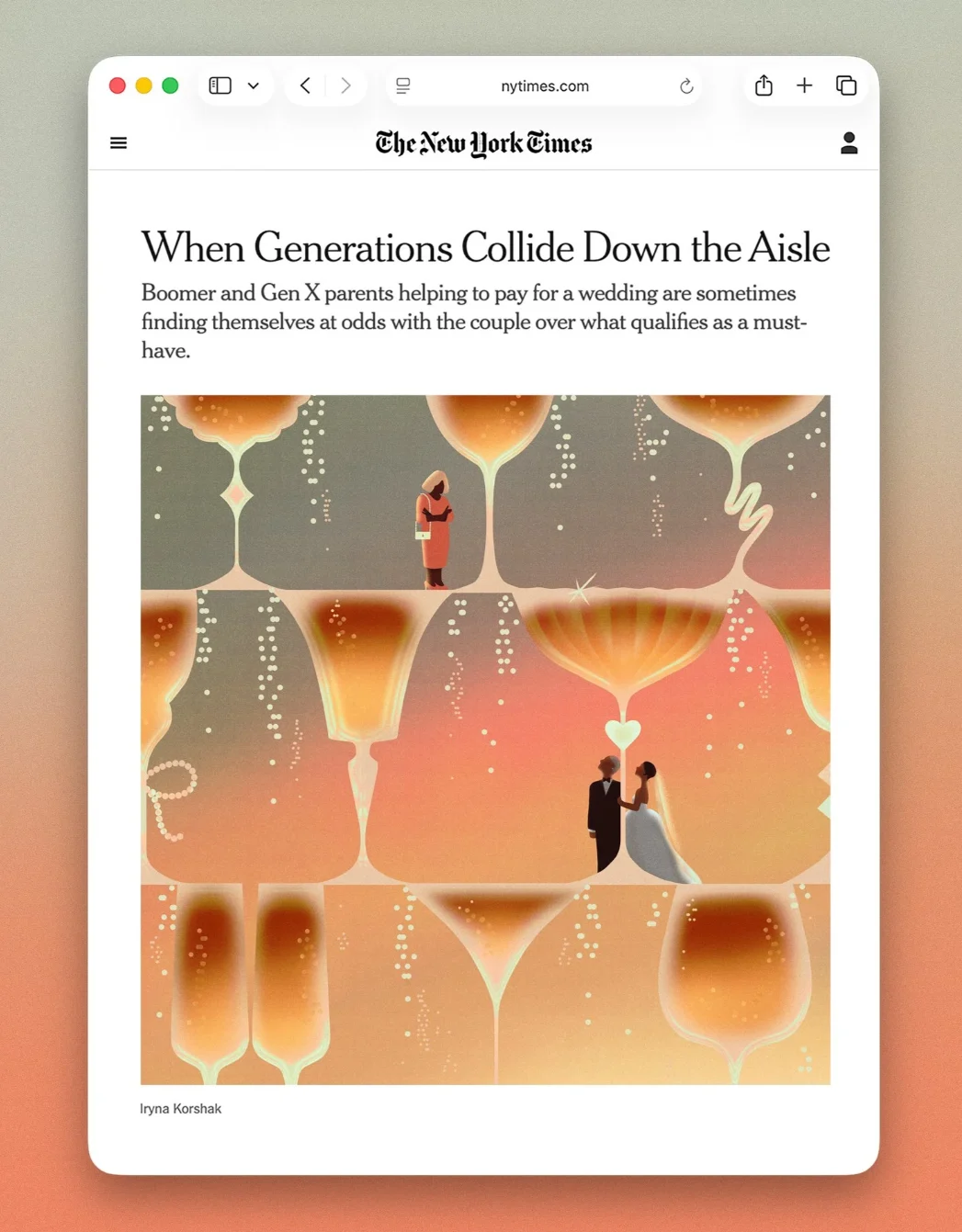
A recent article published by The New York Times, authored by reporter Tammy LaGorce, has brought to light the persistent and often contentious issue of intergenerational conflict in wedding planning. The piece, titled "Generations Disagree on Wedding Planning," delves into the friction between modern couples who aspire to highly personalized wedding experiences and their parents, who frequently contribute financially and often envision a more "timeless" and traditionally structured event. This dynamic, a subject of extensive observation and analysis by Ariel Meadow Stallings, founder of Offbeat Wed, highlights deeper structural issues within the wedding industry and evolving family relationships. Stallings, quoted in the Times article, has dedicated two decades to documenting these exact dynamics, observing the shift from when Gen X couples were planning their nuptials to today, where they often find themselves in the role of the parents of the engaged.
The New York Times piece also featured Emily Berg, an Ohio wedding planner and an active member of Offbeat Wed’s extensive vendor community. This marks the second instance this year that members of the Offbeat Wed network have been cited in the esteemed publication, underscoring the platform’s recognized expertise in nuanced wedding narratives, particularly those deviating from mainstream norms. While the Times article effectively captured the surface-level disagreements over aesthetics and guest lists, it primarily served as a springboard for Offbeat Wed to articulate the underlying systemic challenges that often fuel these familial disputes, providing crucial context for both couples and industry professionals.
The Intergenerational Divide: Personalization Versus Tradition
The core of the conflict often appears to be a simple clash of tastes: couples desire unique, authentic celebrations reflecting their individual identities, while parents often lean towards established customs, elegance, and what they perceive as a "classic" wedding. However, as Stallings points out, this apparent aesthetic disagreement is frequently a symptom of deeper generational and societal shifts. Modern couples, particularly Millennials and Gen Z, have grown up in an era of unprecedented choice and personalization, heavily influenced by digital platforms and social media that showcase an endless array of bespoke possibilities. Their vision of a wedding is often one that breaks free from conventional molds, embracing individuality, sustainability, or cultural fusion.
Conversely, many parents, typically Baby Boomers or Gen X, grew up with a more monolithic vision of weddings, shaped by traditional media, bridal magazines, and societal expectations that emphasized grandeur, formality, and adherence to long-standing rituals. For them, a wedding is not just a personal celebration but also a significant family and social event, reflecting their status, values, and legacy. The financial contributions parents often make to these events—which can be substantial—are frequently accompanied by an expectation of influence over the proceedings, leading to a power dynamic that can quickly escalate into tension.
The Architecture of Influence: How the Wedding Industrial Complex Targets Parents
Ariel Meadow Stallings’s most incisive critique revolves around the strategic marketing practices of what she terms the "wedding industrial complex." She argues that, contrary to popular belief, the mainstream wedding industry does not primarily target the engaged couple. Instead, its most potent messaging is directed squarely at their parents. This observation is critical for understanding the root cause of many intergenerational conflicts.
The wedding industry, a multi-billion-dollar global enterprise, has historically thrived on creating and perpetuating aspirational ideals of what a wedding "should" be. In the United States, the average cost of a wedding has steadily climbed, reaching figures often exceeding $30,000, with some estimates placing it closer to $35,000 nationally. A significant portion of these costs, historically and currently, is borne by the parents of the couple. Data consistently shows that parents contribute to, or fully fund, a substantial percentage of weddings—often over 50%, and in some demographics, even higher.
This financial reality provides the industry with a clear target demographic. Parents, who are often writing the checks, are more susceptible to industry messaging about what a "proper" or "timeless" wedding entails. They grew up in a different media landscape, where traditional authorities—such as established bridal publications, high-end venues, or seasoned event planners—held significant sway. When a venue-mandated coordinator or a traditional florist asserts that certain elements are "essential" or "non-negotiable," many parents internalize these pronouncements as facts. This contrasts sharply with their children, who have spent years navigating a vast ocean of contradictory opinions and alternative ideas online, fostering a more critical and discerning approach to consumer messaging.
Stallings has previously labeled some of this mainstream wedding marketing as "predatory," arguing that it exploits parental desires for their children’s happiness and social standing by dictating expensive, commercially driven traditions that the couple themselves may not value. This often results in a scenario where parents, genuinely believing they are ensuring the "best" wedding, enforce commercial traditions that their children perceive as irrelevant or even restrictive.
Generational Perspectives on Media and Authority
The differing susceptibility to wedding industry messaging is deeply rooted in generational differences in media consumption and trust in authority. Baby Boomers and early Gen X individuals were largely shaped by broadcast media, print publications, and established institutions. Information was more centralized, and expert opinions were often accepted with less scrutiny. This environment fostered a sense of what was "standard" or "correct" for significant life events like weddings.
In contrast, Millennials and Gen Z are digital natives, raised with the internet, social media, and an abundance of user-generated content. They are accustomed to crowdsourcing opinions, seeking out niche communities, and valuing authenticity and personalization above mass-market trends. Their information landscape is decentralized, diverse, and often contradictory, making them naturally more skeptical of top-down commercial directives. They are more likely to question established norms and seek out vendors and ideas that align with their unique visions, even if those visions challenge parental expectations.

This divergence in media literacy and trust creates a fundamental disconnect when planning a wedding. Parents, relying on what they were told was "required," may push for elements like grand ballrooms, specific floral arrangements, or extensive guest lists. Couples, informed by online communities and a desire for meaningful experiences, might prioritize intimate gatherings, unique locations, or sustainable practices. The clash, therefore, is not merely about decor but about differing epistemologies and what constitutes "authority" in decision-making.
Weddings as a Microcosm of Family Dynamics
Beyond the influence of the wedding industrial complex, weddings serve as a potent "petri dish" for existing family dynamics, as Stallings has long observed. All the simmering issues—how a family handles money, the extent to which adult children are treated as autonomous adults, and the family’s capacity for navigating disagreement—become intensely concentrated within the high-stakes environment of wedding planning. This process is further amplified by strict deadlines, significant budgets, extensive guest lists, and heightened emotional states from all parties involved.
For many couples in their twenties or early thirties, wedding planning marks the first time they engage in a high-stakes negotiation with their parents as fellow adults, concerning a matter with substantial financial and emotional weight. Families that lack robust communication infrastructure or have unresolved power imbalances often find these issues exploding during wedding preparations. What might appear as a dispute over the color of tablecloths or the inclusion of a distant relative can quickly reveal deeper struggles over control, respect for autonomy, and the transition of adult children into independent decision-makers. The patterns of these conflicts are, for experienced observers like Stallings, remarkably predictable.
Understanding this phenomenon is not merely an academic exercise; it offers practical utility for wedding vendors, particularly those specializing in non-traditional or personalized events. When a couple approaches a vendor expressing stress over parental conflict, the issue is rarely a simple taste disagreement. Instead, it is often a complex power negotiation, an arena where a family’s communication shortcomings and long-standing dynamics are laid bare. Recognizing this distinction can profoundly shift how vendors listen to their clients, the types of questions they ask, and the efficacy of the support and guidance they can offer. By acting as empathetic mediators or providing strategies for navigating these familial tensions, vendors can offer far more value than simply fulfilling contractual obligations.
The Rise of Offbeat Wed and the Demand for Nuance
The recurring interest from publications like The New York Times in Offbeat Wed and its community underscores a growing recognition within mainstream media of the need for more nuanced, inclusive, and realistic perspectives on weddings. Since its inception in 2007, Offbeat Wed has carved out a unique space by championing individuality and authenticity in wedding celebrations, providing a platform for couples and vendors who defy conventional expectations.
Ariel Meadow Stallings’s two decades of experience observing these dynamics, combined with Offbeat Wed’s extensive network of non-traditional vendors, has positioned her as a go-to expert for journalists seeking to understand the evolving landscape of marriage and family. When Tammy LaGorce sought a source who could offer a long-term perspective on intergenerational wedding conflict, Stallings’s extensive background and unique insights made her an invaluable resource. Furthermore, her ability to connect reporters with "boots on the ground" vendors like Emily Berg, who possess firsthand experience with these complex client scenarios, enriches the reportage with real-world examples and practical implications. The previous NYT feature earlier this year, focusing on neurodivergent and nervous-system-friendly weddings, further illustrates Offbeat Wed’s role in bringing underrepresented perspectives and innovative approaches to the forefront.
Implications for the Wedding Industry and Beyond
The insights gleaned from this intergenerational wedding conflict carry significant implications for the broader wedding industry. Vendors who embrace flexibility, offer transparent communication, and are adept at navigating complex family dynamics are increasingly vital. The traditional "one-size-fits-all" model of wedding planning is becoming less viable as couples demand highly customized experiences. This necessitates a shift in how services are marketed, how contracts are structured, and how client relationships are managed.
For vendors aligned with the "offbeat" ethos, understanding the underlying power dynamics allows them to proactively equip their clients with strategies for managing parental expectations, facilitating difficult conversations, and setting healthy boundaries. This support extends beyond logistical planning to emotional and relational guidance, transforming the vendor’s role into a more holistic one.
Moreover, this discussion extends beyond the wedding industry, offering a lens through which to examine broader societal trends. It reflects evolving definitions of family, adulthood, financial independence, and the ongoing negotiation between individual autonomy and familial obligation. As societal norms continue to shift, the wedding, often seen as a pivotal life event, will continue to serve as a bellwether for these larger cultural transformations.
The continued dialogue, facilitated by platforms like Offbeat Wed and amplified by mainstream media, is crucial. It not only helps couples navigate one of the most significant events of their lives with greater awareness and less stress but also encourages the wedding industry to evolve into a more inclusive, empathetic, and truly client-centric enterprise. The New York Times’s repeated engagement with Offbeat Wed signifies a growing recognition that the future of weddings lies not in rigid tradition, but in the nuanced understanding and celebration of diverse personal and familial narratives.