


For millennia, diamonds have been revered as symbols of enduring love, status, and natural wonder, their formation shrouded in the mysteries of Earth’s deep interior over eons. This perception is rapidly being reshaped by scientific advancements, offering consumers a choice that challenges the very essence of rarity and origin. Lab-grown diamonds, once a niche concept, are now a significant force in the jewelry market, presenting a compelling alternative to their naturally mined counterparts. A 2024 market analysis reveals a striking 43% surge in lab-grown diamond jewelry unit sales, underscoring a profound shift in consumer preference driven by factors such as cost-efficiency, larger carat sizes within budget, and growing awareness of sustainable practices.

The Genesis of the Modern Diamond: From Earth’s Core to the Laboratory
Natural diamonds are the result of an extraordinary geological ballet. Formed under immense pressure and extreme temperatures, typically between 93 to 155 miles below the Earth’s surface, their creation is a process spanning billions of years. Carbon atoms, subjected to pressures of 45 to 60 kilobars and temperatures of 900 to 1,300 degrees Celsius, crystallize into the diamond structure. These conditions are most commonly found beneath ancient, stable continental cratons. The process often involves carbon sources like carbon dioxide and methane, which, through metasomatic fluids, are transformed into diamond crystals. The journey from the Earth’s mantle to the surface is facilitated by rapid volcanic eruptions, which bring these precious gems to depths accessible for mining. This ancient geological narrative imbues natural diamonds with a sense of history and inherent rarity, as new major deposits are exceptionally scarce.
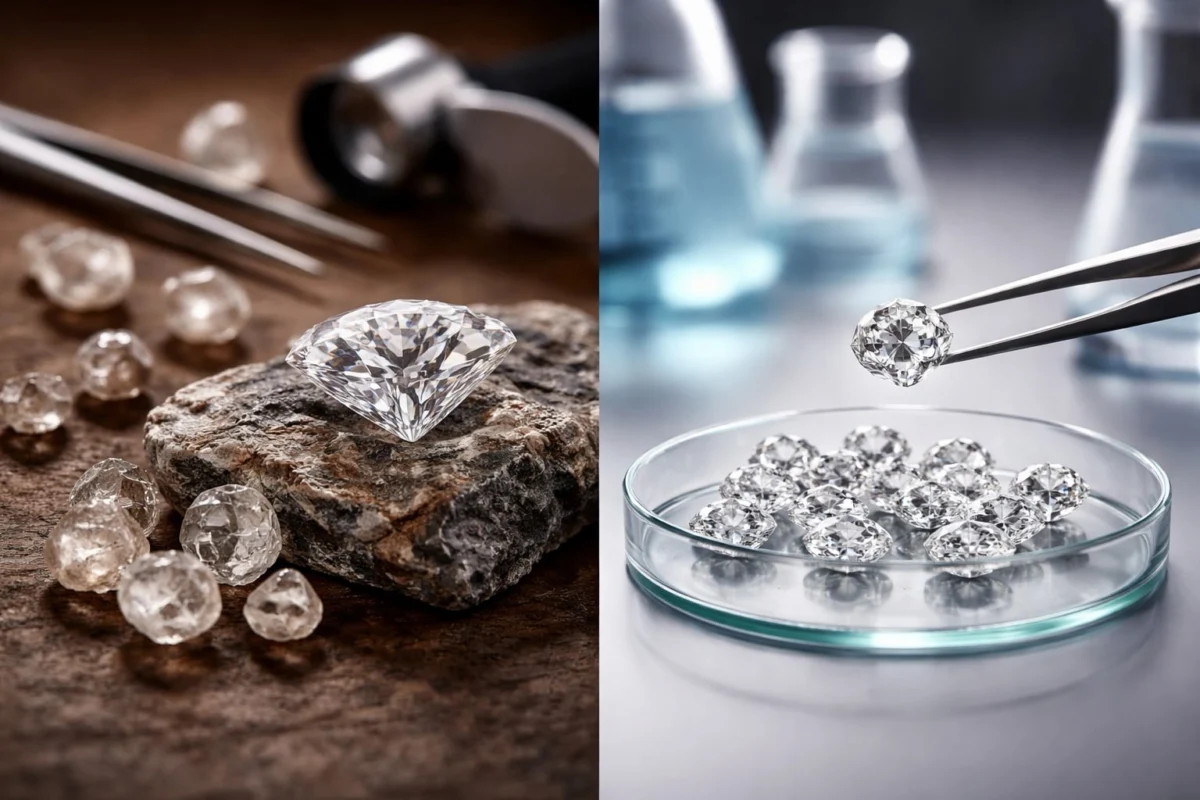
In stark contrast, lab-grown diamonds replicate these intense conditions in highly controlled technological environments. The two primary methods employed are High-Pressure, High-Temperature (HPHT) and Chemical Vapor Deposition (CVD). The HPHT method closely mimics natural diamond formation by subjecting a carbon seed to extreme pressures (over a million pounds per square inch) and temperatures (around 2,000 degrees Celsius) in a specialized press. Carbon atoms from a source material then deposit onto the seed, slowly building the diamond crystal layer by layer.

The CVD process, on the other hand, involves placing a small diamond seed in a vacuum chamber filled with carbon-rich gases, such as methane, and hydrogen. This mixture is then heated to temperatures around 800 degrees Celsius, and microwave energy is applied to break down the gases. Free carbon atoms then deposit onto the diamond seed, growing the crystal structure over a period of weeks. Both methods allow for precise control over the growth process, resulting in diamonds that are chemically, physically, and optically identical to natural diamonds.
Unveiling the Science: Identical Properties, Different Origins
The scientific consensus, supported by leading gemological laboratories like the Gemological Institute of America (GIA) and the International Gemological Institute (IGI), is that lab-grown diamonds are genuine diamonds. They possess the same carbon structure, hardness (a perfect 10 on the Mohs scale), brilliance, fire, and durability as their mined counterparts. The fundamental difference lies solely in their origin – one is a product of billions of years of geological activity, the other a testament to human ingenuity and scientific precision.

Certification plays a crucial role in validating the quality and origin of both types of diamonds. Reputable laboratories meticulously assess diamonds based on the universally recognized 4Cs: cut, color, clarity, and carat weight. Reports from these institutions provide detailed information on a diamond’s characteristics, ensuring transparency for consumers. While specialized equipment is required to distinguish between lab-grown and natural diamonds by identifying subtle growth patterns or trace elements, their performance and aesthetic qualities remain indistinguishable to the naked eye.
Market Dynamics and Consumer Choices: The Rise of the Lab-Grown Gem
The burgeoning popularity of lab-grown diamonds is significantly influenced by their cost-effectiveness. Typically, lab-grown diamonds can be purchased for 60-80% less than natural diamonds of comparable grade. This price disparity allows consumers to opt for larger carat weights, higher clarity grades, or superior color grades within the same budget. For instance, a 2-carat lab-grown diamond might be attainable for the price of a 1-carat natural diamond of similar quality. This affordability has democratized access to larger and more visually impressive diamonds, particularly for engagement rings, a market segment that has seen substantial growth in lab-grown adoption.

The market for lab-grown diamonds has experienced rapid expansion. Industry reports from 2024 highlight that sales volume for lab-grown diamond jewelry has increased by an impressive 43%. This trend is not merely a fleeting fad but reflects a sustained shift in consumer purchasing habits. Factors contributing to this include increased awareness of ethical sourcing and environmental concerns associated with mining, coupled with the undeniable economic advantage offered by lab-grown alternatives.
The Nuances of Value: Rarity, Scarcity, and Long-Term Investment
The discussion of value between lab-grown and natural diamonds often centers on rarity and resale potential. Natural diamonds, by virtue of their geological scarcity and the complex extraction process, tend to hold their value more steadily over time. While consumer-grade diamonds are rarely considered sound financial investments due to depreciation upon purchase, natural diamonds generally exhibit a more stable resale market.

Lab-grown diamonds, on the other hand, are subject to rapid technological advancements and increasing production capacity. As manufacturing becomes more efficient and scalable, prices are expected to continue declining. Consequently, the resale value of lab-grown diamonds is considerably lower and depreciates more quickly. A lab-grown diamond purchased today might fetch a fraction of its original price in a few years, whereas a natural diamond, while also depreciating, typically retains a larger percentage of its initial cost. This distinction is critical for buyers who prioritize long-term value retention or view their diamond purchase as an investment.
Ethical Considerations and Environmental Footprints
The environmental impact of diamond mining has become a growing concern for consumers. Large-scale mining operations can have significant ecological footprints, involving habitat disruption, water usage, and energy consumption. While the exact environmental impact varies greatly by mine and region, the perceived ethical and environmental advantages of lab-grown diamonds are a strong draw for many. Lab-grown diamond production, while energy-intensive, can be powered by renewable energy sources, offering a potentially more sustainable alternative. The controlled factory environment also eliminates concerns about conflict diamonds, ensuring a transparent and ethical supply chain.

The Future of Brilliance: Choice and Personalization
The emergence of lab-grown diamonds has undoubtedly expanded consumer choice. Both lab-grown and natural diamonds offer exceptional beauty, durability, and brilliance. The decision between them hinges on individual priorities:
- Budget: For those seeking larger or higher-quality diamonds at a more accessible price point, lab-grown diamonds are often the more practical choice.
- Origin and Symbolism: Consumers who value the romantic narrative of Earth’s ancient processes, the allure of natural rarity, and the prestige associated with geological history may lean towards natural diamonds.
- Sustainability and Ethics: Individuals prioritizing a lower environmental impact and an ethically transparent supply chain might find lab-grown diamonds more appealing.
- Investment Potential: Those viewing their diamond purchase as a long-term store of value may prefer natural diamonds due to their historically stronger resale market.
Ultimately, the diamond market is evolving, driven by innovation and changing consumer values. The scientific fact remains: both lab-grown and natural diamonds are true diamonds, offering unparalleled beauty and enduring qualities. The choice is now more personal than ever, allowing individuals to select a gem that aligns perfectly with their budget, their values, and the unique story they wish to tell. The ongoing dialogue and consumer education surrounding these choices will continue to shape the future of the diamond industry, ensuring that brilliance, in all its forms, remains accessible and meaningful.