


You’re standing at the jewelry counter, heart racing, wondering if that stunning diamond catching the light is worth your hard-earned money. The truth is, understanding the real differences between lab-grown diamonds and cubic zirconia changes everything about how you shop for sparkle. Are lab-grown diamonds worth it compared to their budget-friendly cubic zirconia cousins? This guide breaks down the science, durability, brilliance, and price points so you can confidently choose the perfect affordable sparkle between lab-grown diamond or cubic zirconia for your dream jewelry piece, without buyer’s remorse or budget regrets.
As the largest diamond and jewelry forum, PriceScope connects you with experts and real shoppers who’ve already walked this path, offering honest comparisons about lab-created diamonds, simulants, optical properties, and long-term value. Whether you’re hunting for an engagement ring, anniversary gift, or everyday earrings, you’ll find the guidance you need to make a choice that matches both your vision and your wallet.
Looking for a Certified Lab-Grown Diamond?
If you’ve decided that a lab-grown diamond is the right fit, choosing the right vendor matters just as much as choosing the right stone. We only recommend retailers with consistent feedback, strong quality control, and transparent grading.
Whiteflash sits at the top of our vetted list, known for precision-cut diamonds and detailed performance data. James Allen offers one of the largest online selections with 360° imaging on every diamond. Blue Nile combines broad inventory with flexible payment options that make larger purchases more manageable.
Explore inventory, compare reports, and choose a diamond backed by documentation you can verify.
What Are Lab-Grown Diamonds, And How Are They Made?
Lab-grown diamonds represent a transforming advancement in gemology, providing authentic diamonds that match the composition and qualities of those formed naturally deep within the Earth. These gems are engineered in sophisticated labs through methods that either mimic geological pressures or use gas-based deposition, resulting in high-quality diamonds available in weeks rather than eons. Since their development in the mid-20th century, they’ve gained traction for offering comparable beauty and durability at lower prices, with enhanced customization options and improved supply chain visibility.
Lab-grown diamonds are true diamonds synthesized in controlled facilities, consisting purely of carbon atoms bonded in a crystalline lattice identical to natural versions. This structure confers the same inherent properties, such as exceptional hardness and low refractive index, making them indistinguishable without specialized tools. Unlike simulants, they qualify as real diamonds under industry standards and are graded using the same criteria for cut, color, clarity, and carat weight.
The creation process begins with a tiny diamond seed, often sourced from prior lab production, which serves as the foundation for new crystal growth. This seed ensures the resulting gem replicates the tetrahedral arrangement of carbon, yielding diamonds that pass all tests for authenticity. In essence, the lab environment accelerates what nature achieves over billions of years, producing gems free from the variability of underground formation.

These diamonds can incorporate trace elements like nitrogen or boron during synthesis, influencing hues from colorless to fancy colors like yellow or blue. This controlled addition allows for tailored designs, but quality assurance relies on post-growth evaluations to confirm structural integrity and optical performance.
Origins and History of Lab-Grown Diamonds
The concept of lab-grown diamonds emerged in the 1950s, when scientists first achieved diamond synthesis for industrial use, building on earlier experiments with carbon under extreme conditions. General Electric pioneered the High Pressure High Temperature (HPHT) method in 1954, initially focusing on abrasive tools rather than jewelry. By the 1970s, advances enabled gem-quality production, though early diamonds were small and often colored.
The 1980s and 1990s saw refinements, with Chemical Vapor Deposition (CVD) gaining prominence as a complementary technique offering greater purity. This evolution was driven by technological progress in materials science and expanding commercial applications. Today, global production has scaled dramatically, with labs in the U.S., India, and China leading output for both utilitarian and ornamental uses.
Historical breakthroughs stemmed from wartime research into high-pressure systems, which transitioned from secret labs to commercial viability. This timeline underscores a shift from novelty to mainstream, influenced by broader consumer interest in alternative production methods and advancements in high-pressure technology.
The High-Pressure High-Temperature (HPHT) Manufacturing Process
HPHT replicates Earth’s mantle conditions to transform carbon into diamonds, using specialized presses to apply high pressure and high temperature. A small diamond seed is placed in a chamber containing graphite or another carbon source and a metal solvent, such as nickel or iron, which facilitates dissolution and recrystallization of the carbon. The setup is then subjected to pressures around 5-6 gigapascals and temperatures of 1,300-1,600 degrees Celsius for several days to weeks.
During this phase, the carbon melts and bonds to the seed, forming a rough crystal that grows layer by layer. Once complete, the chamber is cooled gradually to prevent cracking, and the diamond is removed for cleaning and initial assessment. This method excels at producing smaller, high-clarity diamonds but may introduce metallic inclusions from the catalyst.
HPHT variations include belt, cubic, and split-sphere presses, each optimized for scale and efficiency. While effective for colorless or colored diamonds, post-treatments can enhance quality; however, their energy-intensive nature requires precise engineering controls to maintain consistent crystal growth.
The Chemical Vapor Deposition (CVD) Manufacturing Process
CVD grows diamonds by depositing carbon atoms from a gas mixture onto a seed in a vacuum chamber, operating at lower pressures than HPHT. The process begins by placing diamond seeds, up to dozens, on a disc, into the chamber, then introducing gases like methane and hydrogen. A plasma is generated to break down the gases at 700-1,200 degrees Celsius, releasing carbon that adheres to the seeds.

Over 4-6 weeks, layers accumulate, forming pure crystals, with periodic pauses to remove graphite buildup and maintain single-crystal growth. Once the target size is reached, the diamonds are removed and often undergo HPHT treatment to refine color or clarity. This technique allows for larger diamonds with fewer impurities, ideal for customization.
CVD’s precision stems from microwave- or hot-filament-activated plasma, which enables control over growth rates and defect formation. Though time-consuming, it minimizes metallic residues, supporting applications where optical purity is paramount, and relies on documented production controls and post-growth grading verification.
Key Properties and Characteristics of Lab-Grown Diamonds
Lab-grown diamonds are the hardest, scoring a 10 on the Mohs scale, ensuring unmatched scratch and wear resistance compared with most materials. Their refractive index of about 2.42 produces brilliant sparkle through superior light bending and dispersion, creating fire and scintillation akin to natural counterparts. Clarity often surpasses that of mined diamonds due to fewer inclusions, though variations can occur depending on the method used.
Color ranges from D (colorless) to Z or fancy shades, graded by labs like GIA, with options for intentional tinting. These gems maintain thermal conductivity and chemical stability, making them suitable for both adornment and tech. However, subtle growth patterns detectable under magnification distinguish them from natural ones.
Their identical atomic structure enables efficient heat dissipation, which is valuable in electronics, while their durability supports long-term value. Quality hinges on production controls, with certifications verifying traits without overstating inherent advantages.
Uses and Considerations for Lab-Grown Diamonds in Jewelry
In jewelry, lab-grown diamonds shine in engagement rings, earrings, and necklaces, providing access to a wide range of sizes and quality grades at varied price points. Vendors like James Allen, Blue Nile, and Whiteflash feature extensive inventories, complete with 360-degree imaging and GIA reports, enabling informed selections based on personal style and budget. Their versatility extends to custom pieces, where precise engineering matches specific shapes or colors.
Overall, these diamonds suit those seeking genuine gems with modern benefits, but decisions should weigh longevity against preferences to ensure alignment with verified documentation and confidence in provenance.
When buyers understand they are selecting real diamonds created in controlled laboratory environments, customizable specifications, and verifiable quality documentation, the decision shifts from “Should I?” to “Which one matches my vision?” That confidence matters, especially when you’re investing thousands in something meant to last generations.

But knowing how lab-grown diamonds are made only tells half the story. The other option sitting on that comparison chart looks remarkably similar in photos, yet costs a fraction of the price.
Further Insights
What Are Cubic Zirconia, And How Are They Made?
Cubic zirconia, commonly known as CZ, is an affordable, visually striking alternative to diamonds in jewelry, captivating many with its bright shine and clarity. Unlike natural gems formed over eons underground, CZ is entirely human-engineered from basic compounds, making it a staple in budget-friendly accessories. This lab-created material has grown in popularity since its commercial debut in the 1970s, offering a way for people to enjoy diamond-like elegance without the costs associated with mined diamonds.
Cubic zirconia refers to a synthetic crystalline substance composed primarily of zirconium dioxide, a compound that takes on a cubic structure at the atomic level. This form allows it to exhibit properties such as a high refractive index, giving it a dazzling appearance that closely resembles more precious diamonds. While trace amounts of natural CZ occur in certain minerals, all versions used in jewelry today are produced synthetically to ensure consistency and quality.
The material’s appeal lies in its ability to be manufactured flawlessly, often appearing colorless and free of inclusions that might occur in earth-formed gems. This purity contributes to its widespread use in rings, earrings, and necklaces, where it provides an accessible entry point into fine-looking adornments. However, it’s important to note that CZ is classified as a simulant rather than a true diamond equivalent, meaning it imitates visual traits without sharing the same chemical makeup.
CZ’s composition sets it apart from other synthetics; zirconium dioxide stabilizes in its cubic phase only under specific conditions, preventing it from reverting to less desirable forms. This stability ensures the final product maintains its shape and optical qualities, making it reliable for everyday wear despite not matching the extreme hardness of alternatives.
Ready to Upgrade from Cubic Zirconia?
If this guide helped you decide that a genuine lab-grown diamond better fits your goals, the next step is choosing a trusted source. We recommend only retailers with strong reputations, verified grading, and consistent buyer feedback.
At the top of our list is Whiteflash, respected for premium cut quality and detailed documentation. James Allen stands out for its extensive inventory and interactive viewing tools. Blue Nile rounds out the list with competitive pricing and attractive payment options that make upgrading easier.
Start with vendors known for quality, not just price – and make your final decision with confidence.

The Origins and History of Cubic Zirconia
The story of cubic zirconia begins in the scientific scope, with its natural occurrence first noted in 1937 as minute crystals within zircon minerals, though far too small for practical use. It wasn’t until the 1960s that researchers in France and the Soviet Union experimented with creating larger, usable versions in laboratories, driven by the quest for cost-effective diamond look-alikes. By the early 1970s, Soviet scientists had perfected a method for commercial production, leading to its market introduction around 1976.
This breakthrough transformed the jewelry industry, as CZ quickly became the leading diamond imitation due to its affordability and visual similarity. Production ramped up globally, with annual output reaching tens of millions of carats by the 1980s, fueled by patents and technological refinements. Today, it remains a key player in the fashion and bridal markets, evolving with additions such as colored variants to broaden its appeal.
The historical push for CZ stemmed from materials science advancements during the Cold War, when high-temperature techniques were adapted from industrial applications. This context highlights how geopolitical innovation indirectly influenced consumer goods, positioning CZ as a widely accessible alternative in fashion jewelry markets.
The Manufacturing Process of Cubic Zirconia
Creating cubic zirconia involves a high-tech melting process known as skull melting, in which zirconium oxide powder is combined with stabilizers such as calcium oxide or yttrium oxide to maintain the desired cubic crystal structure. The mixture is placed in a specialized crucible, often made from copper and water-cooled, and heated to extreme temperatures exceeding 4,900 degrees Fahrenheit using radio-frequency induction. This intense heat melts the core while the outer layer remains solid, forming a “skull” that contains the molten material.
As the melt stabilizes, it is cooled gradually over several hours or days, allowing crystals to form and grow within the container. Once solidified, the mass is removed, and the crystals are separated, inspected for quality, and then cut and polished into various shapes for jewelry settings. This controlled environment ensures uniformity and minimal defects compared with natural formations.
The process’s precision is crucial; variations in temperature or stabilizer ratios can alter the crystal’s clarity or color, affecting its market value. Modern refinements include adding trace elements to produce hues such as pink or blue, expanding CZ’s versatility beyond clear imitations. This method’s efficiency keeps costs low, enabling large-scale production through controlled laboratory processes.
Key Properties and Characteristics of Cubic Zirconia
Cubic zirconia has an impressive refractive index of approximately 2.15-2.18, which enables strong light dispersion and a brilliant, often fiery sparkle. This creates rainbow-like flashes that can appear more vivid than those from some natural gems, appealing to those seeking bold visual effects. Additionally, its hardness is 8-8.5 on the Mohs scale, providing good scratch resistance for occasional wear.
Beyond visuals, CZ is typically flawless and colorless unless intentionally doped with elements for variety, making it ideal for mass-produced items. However, over time, it can accumulate surface abrasions or cloudiness from exposure to oils and chemicals, which diminishes its luster compared to harder materials. Its density, higher than many gems, also gives it a substantial feel in the hand.

These properties make CZ suitable for educational gemology tools, helping demonstrate principles of light interaction. Yet, its simulant status means it does not carry the same market recognition or resale structure as diamonds.
Uses and Considerations for Cubic Zirconia in Jewelry
In the world of adornments, cubic zirconia finds its niche in affordable pieces like engagement rings, pendants, and studs, where it offers diamond-like aesthetics at a fraction of the price. Its versatility extends to custom designs, which can be set in gold, silver, or platinum for a range of looks.
Ultimately, CZ’s role underscores a shift toward accessible luxury, but informed choices require understanding its durability and value retention limitations, ensuring it aligns with personal needs.
Now that you understand what cubic zirconia actually is, the natural question becomes how it stacks up against lab-grown diamonds when you’re comparing specific diamonds for a real purchase.
Further Insights
Many people assume that affordable diamond alternatives like cubic zirconia are the ultimate budget-friendly choice for sparkling jewelry, but this assumption overlooks lab-grown diamonds, a game-changer that’s redefining value in the market.
Lab-grown diamonds share the same chemical and physical properties as natural diamonds and are typically priced below comparable natural equivalents. Lab-grown diamonds represent a growing share of engagement ring purchases in several markets. For instance, industry reports from 2023 indicated that lab-grown diamonds accounted for over 40% of engagement ring sales in the United States.
When comparing lab-grown diamonds to cubic zirconia, it’s essential to recognize that while both serve as alternatives to mined diamonds, they differ fundamentally in makeup, performance, and long-term appeal. Lab-grown diamonds are genuine diamonds created in controlled settings and offer identical characteristics to their natural counterparts, whereas cubic zirconia is a synthetic simulant designed to mimic the appearance but lacks the same intrinsic qualities.
Chemical Composition
At the core of the distinction between lab-grown diamonds and cubic zirconia is their composition, which influences everything from durability to visual appeal and overall value.

Lab-grown diamonds consist entirely of carbon atoms arranged in a precise crystal lattice, mirroring the structure found in naturally formed diamonds. Produced through sophisticated techniques such as High-Pressure High-Temperature (HPHT) or Chemical Vapor Deposition (CVD), these methods simulate Earth’s extreme conditions to yield diamonds with the exact same physical and chemical properties as mined diamonds. This pure carbon foundation delivers unmatched toughness, achieving a top rating of 10 on the Mohs hardness scale, and delivers the signature radiance that defines diamond jewelry.
Cubic zirconia, by contrast, is formulated from zirconium dioxide, a compound devoid of any carbon content. Its cubic crystalline form is engineered in labs to produce a bright, eye-catching gleam, but this composition makes it inherently less robust, registering between 8 and 8.5 on the Mohs scale and thus more vulnerable to everyday damage. The absence of carbon also means it doesn’t replicate the authentic diamond’s properties, often resulting in a flashier but less elegant light play that can appear artificial on closer inspection.
Appearance
The visual qualities of lab-grown diamonds and cubic zirconia differ in how they interact with light, affecting their overall elegance and suitability for fine jewelry.
Lab-grown diamonds exhibit the same optical excellence as natural diamonds, thanks to their identical carbon-based structure, which allows for brilliant white light reflection and colorful light dispersion known as fire. With a refractive index of about 2.42, they produce a sharp, sophisticated sparkle, which is the hallmark of high-quality diamonds. Moreover, these diamonds can feature minor inclusions from the growth process, adding a natural character similar to mined diamonds, though often with enhanced clarity due to precise manufacturing controls.
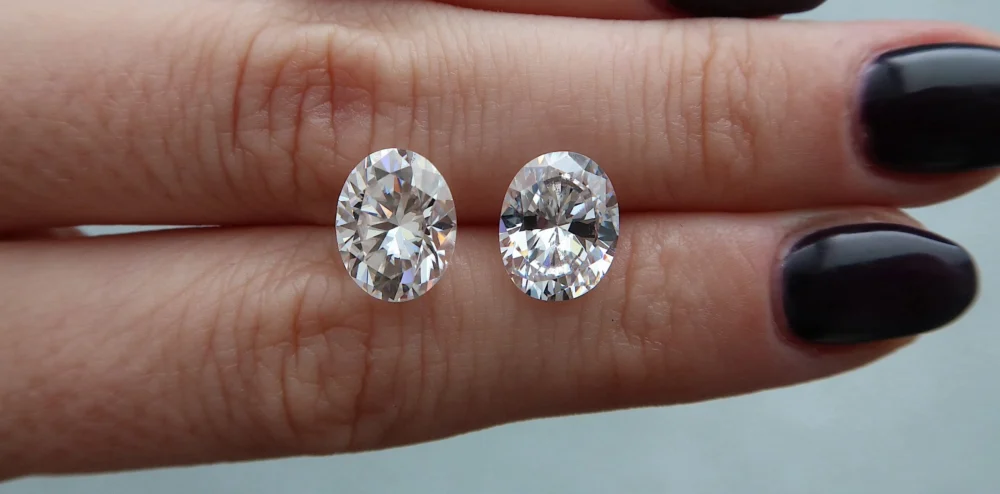
Cubic zirconia boasts a higher light dispersion rate, typically 0.058 to 0.066, versus a diamond’s 0.044, creating vivid rainbow-like flashes that can initially captivate but may appear overly dramatic or less refined in various lighting. Its refractive index ranges from 2.15 to 2.18, yielding slightly softer brilliance than diamonds. Because it is produced without inherent flaws, cubic zirconia often appears exceptionally clear, which some view as a plus for uniformity, yet it can come across as unnaturally perfect, diminishing the organic allure that diamonds provide.
Environmental Impact
When comparing lab-grown diamonds and cubic zirconia, some buyers look at how each material is produced. However, being created in a laboratory does not automatically mean a product is environmentally friendly or ethically superior. The impact depends heavily on how and where the material is manufactured.
Lab-grown diamonds are produced in controlled facilities rather than extracted through mining. While this avoids large-scale excavation, the creation process requires significant energy input, particularly for HPHT and CVD growth systems. Energy sources, facility efficiency, and operational standards vary widely between producers. As a result, the overall footprint differs from one manufacturer to another. For instance, some reports suggest that the carbon footprint per carat of lab-grown diamonds can range significantly based on the energy mix used in their production.
Cubic zirconia is also produced in laboratory settings using high-temperature melting processes. Although the material itself is less energy-intensive to produce than diamond in many cases, manufacturing conditions and power sources still determine the overall impact. Public reporting on production standards can be limited.
In short, laboratory creation alone does not guarantee lower environmental impact or ethical advantages. Buyers interested in these factors should review producer-specific information rather than assuming one material is automatically “greener” than the other.
Color
Color variations in lab-grown diamonds and cubic zirconia stem from their creation methods and materials, influencing their aesthetic versatility and perceived authenticity.
Lab-grown diamonds range from colorless to fancy hues, graded by institutions such as the Gemological Institute of America (GIA) on a scale from D (completely colorless) to Z (noticeable yellow or brown tones). Elements like nitrogen or boron introduced during growth can produce yellows or blues, enabling manufacturers to craft vibrant options or pristine, clear diamonds through refined HPHT and CVD techniques. This flexibility enables custom designs that retain the subtle depth and permanence typical of diamonds.
Cubic zirconia is inherently colorless and free of imperfections, which can make it appealing for a uniform look, but it often lacks the nuanced variations that give diamonds their character. Producers can add pigments to simulate colored gemstones, but these tend to appear more intense and less layered than natural diamond colors. Exposure to elements over time may cause cubic zirconia to develop haze or discoloration, whereas lab-grown diamonds preserve their hue indefinitely due to their stable composition.
Compare Cut Quality Before You Buy
Not all lab-grown diamonds are created equal. Cut precision, light performance, and grading consistency vary from seller to seller. That’s why we focus on vendors with proven quality standards and reliable customer experiences.
Whiteflash is known for its strict cut standards and in-house quality control. James Allen provides high-resolution video so you can examine the diamond before purchasing. Blue Nile offers a streamlined buying experience and practical financing options for added flexibility.
If you’re investing in a real diamond, start with vendors that prioritize transparency and long-term satisfaction.
Price
Pricing structures for lab-grown diamonds and cubic zirconia reflect their production efficiencies, material costs, and market positioning, making them accessible yet retaining distinct value.

Lab-grown diamonds typically retail at 30-50% less than comparable natural diamonds, driven by streamlined lab processes that bypass mining expenses and shorten supply chains. Despite the savings, they command premium prices based on the 4 Cs (carat, cut, color, and clarity), ensuring they retain substantial value as true diamonds with enduring appeal. This balance makes them an attractive investment for those wanting quality without the traditional markup. For example, a 1-carat, G-color, VS1-clarity lab-grown diamond might range from $1,500 to $3,000, whereas a natural diamond of similar specifications could cost $5,000 to $10,000 or more.
Cubic zirconia stands out for its extreme affordability, often significantly less expensive than diamonds of any origin, with a one-carat piece available for just $10-30, driven by lower-cost materials and high-volume production. While ideal for casual or temporary wear, its low cost aligns with reduced longevity and minimal resale potential. For lasting pieces, lab-grown diamonds offer better overall value due to their superior resilience and market desirability.
But understanding these technical and practical differences still leaves one crucial question unanswered: which option actually deserves your money for the specific piece you’re planning to buy?
Which Is Better: Lab-Grown Diamonds or Cubic Zirconia
Deciding between lab-grown diamonds and cubic zirconia for your jewelry, particularly something meaningful like an engagement ring, comes down to your core priorities and what you want from a center diamond long-term. Both provide impressive sparkle as more accessible options compared to mined diamonds, but they serve very different purposes—one delivers genuine diamond authenticity with enduring performance, while the other prioritizes ultra-low cost and initial eye-catching shine. There’s no universal “better” choice; it depends on whether you value lasting, genuine-diamond qualities or maximum affordability for temporary or fashion-focused pieces.
Choose Cubic Zirconia If You Want Extreme Affordability and Bold Initial Sparkle
Cubic zirconia excels for shoppers on a very tight budget who want dramatic, attention-grabbing brilliance without spending much. Its higher light dispersion creates vivid rainbow flashes that can outshine traditional diamond fire in certain lighting conditions, making it ideal for statement pieces, fashion jewelry, or one-time events where the wow factor matters most up front.
This material allows you to get larger sizes or more intricate designs at a tiny fraction of diamond costs, often just dollars instead of thousands, offering tremendous flexibility for experimenting with styles or accessorizing without financial strain. If your main goal is eye-catching presence on a minimal budget with no plans for heirloom status, cubic zirconia delivers strong short-term appeal.
That said, its lower hardness means it may not hold up as well over years of daily wear, so it’s best suited for pieces that see occasional use or can be replaced easily.
Choose Lab-Grown Diamonds If You Prioritize Authenticity, Durability, and Timeless Diamond Appeal
Lab-grown diamonds provide genuine diamond composition and properties, essentially identical chemical composition and optical properties to mined diamonds, ensuring that classic, refined white brilliance and subtle fire, which many people associate with fine jewelry. They look and feel indistinguishable from natural diamonds to the eye and under professional grading, providing the traditional prestige without anyone questioning whether they’re “real.”

With a perfect 10 on the Mohs hardness scale, they resist scratches, chips, and dulling far better than softer alternatives, making them excellent for everyday wear in rings or other high-contact pieces that need to stay sharp and clear for decades. Reliable certifications from labs like GIA add transparency on quality, and you still enjoy major savings, typically 30-50% or more off comparable natural diamond prices, while offering long-term durability and consistent grading documentation. Retailers like James Allen, Blue Nile, and Whiteflash offer extensive lab-grown selections with 360-degree views, detailed reports, and quality guarantees to help you find the perfect match.
If you want unquestionable diamond identity, superior scratch resistance, and a piece built for lifelong significance, lab-grown diamonds stand out as the stronger, more versatile option.
Finding the Best Fit for Your Needs
Think about your lifestyle and goals: Do you want bold, colorful flashes on a very low budget for fun or temporary jewelry, or do you prefer the authentic depth, unmatched toughness, and classic elegance of a true diamond for something meant to last? Trying pieces in various lighting conditions often makes the differences clear, as personal preference drives the final call.
Most buyers start by browsing vendor sites individually, comparing specs across multiple tabs while trying to remember which diamond had better clarity or which retailer offered superior cut quality. As options multiply and technical details blur together, the process becomes overwhelming rather than empowering. PriceScope centralizes this research by letting you compare certified lab-grown diamonds from trusted vendors side by side, access detailed cut quality analysis, review current pricing trends, and tap into forum discussions where thousands of experienced buyers share real-world insights on everything from vendor reliability to long-term diamond performance.
Whether you go with the bold, budget-friendly shine of cubic zirconia or the authentic, enduring appeal of a lab-grown diamond, starting with solid research ensures you’ll end up with a choice you’ll cherish. The platform provides comprehensive guides on the 4Cs, vendor quote request tools, monthly price charts, and active community forums where members help each other navigate decisions confidently and avoid common pitfalls.
But getting the education and comparison tools is only half the equation when you’re ready to make this investment.
Join the Largest Diamond and Jewelry Forum
The other half comes from connecting with people who’ve already walked this path. You need a place where someone who bought a lab-grown diamond three years ago can tell you how it’s held up. Where gemologists explain why certain clarity grades matter more in larger diamonds. Where you can post photos of two options you’re considering and get honest feedback from people who have no commission riding on your choice.
PriceScope has built exactly that community over two decades, bringing together over 100,000 members across 200,000+ forum threads. You’ll find discussions comparing specific vendors’ customer service, debates about whether certain inclusions affect brilliance in real-world conditions, and detailed breakdowns of how cut quality impacts light performance between lab-grown and natural diamonds.

The platform combines peer knowledge with practical tools, including the Holloway Cut Advisor for evaluating round diamond proportions, comprehensive 4Cs education that goes beyond basic definitions, and direct comparison capabilities across vetted retailers such as Whiteflash, James Allen, and Blue Nile. The goal is straightforward information and peer discussion rather than sales messaging. Just straightforward information from people who’ve spent their own money and lived with the results.
When you’re ready to move from research to decision, that’s where community insight becomes invaluable. You can ask whether a specific inclusion pattern will bother you daily or remain invisible to everyone but a gemologist. You can learn which vendors handle custom requests well and which create friction. You may find that the “deal” you found involves compromises other buyers regret. This collective experience turns abstract specifications into practical guidance about what actually matters when you’re wearing the piece every day for years.