



The realm of fine jewelry is experiencing a significant evolution, with consumers increasingly exploring alternatives to traditional mined diamonds. Among the most popular choices are lab-grown diamonds and moissanite, both offering distinct advantages in terms of price, ethics, and aesthetics. Understanding the fundamental differences between these two captivating gemstones is crucial for making a purchase that aligns with personal style, budget, and values. This in-depth guide delves into the science, characteristics, and market dynamics of lab-grown diamonds and moissanite, empowering buyers with the knowledge to navigate their options with confidence.
Understanding Lab-Grown Diamonds: The Science of a Real Diamond
Lab-grown diamonds, also referred to as laboratory-created, synthetic, or cultured diamonds, are not imitations but genuine diamonds. They are produced in controlled laboratory environments through advanced technological processes that replicate the geological conditions under which natural diamonds form deep within the Earth. The fundamental composition of a lab-grown diamond is identical to that of a mined diamond: pure carbon atoms arranged in a cubic crystal lattice structure. This shared molecular structure ensures that lab-grown diamonds possess the same chemical, physical, and optical properties as their earth-mined counterparts, including exceptional hardness, brilliance, and fire.
The creation of lab-grown diamonds typically involves two primary methods: High-Pressure High-Temperature (HPHT) and Chemical Vapor Deposition (CVD). The HPHT method involves subjecting a diamond seed crystal to extreme pressures (up to 1.5 million pounds per square inch) and temperatures (exceeding 2,000 degrees Fahrenheit), mirroring the conditions in the Earth’s mantle. Carbon material is dissolved and then crystallizes onto the seed, allowing the diamond to grow layer by layer. The CVD process, conversely, utilizes a vacuum chamber where carbon-rich gases are introduced at high temperatures. These gases decompose, and carbon atoms deposit onto a diamond seed plate, gradually forming a larger diamond crystal. Both techniques result in high-quality diamonds that are indistinguishable from natural diamonds to the naked eye and are graded according to the same stringent standards.

The Gemological Grading of Lab-Grown Diamonds
Like natural diamonds, lab-grown diamonds are meticulously graded based on the universally recognized "4Cs": cut, color, clarity, and carat weight. Reputable gemological laboratories, such as the Gemological Institute of America (GIA) and the International Gemological Institute (IGI), provide certifications for lab-grown diamonds, detailing their specific characteristics within these categories.
- Cut: This refers to the proportions, symmetry, and polish of a diamond, significantly influencing its brilliance and sparkle. An excellent cut maximizes the reflection of light.
- Color: Diamond color is graded on a scale from D (colorless) to Z (light yellow or brown). Near-colorless (D-F) and colorless (G-J) diamonds are highly sought after for their lack of discernible yellow or brown tints.
- Clarity: This measures the presence of internal inclusions or external blemishes. Diamonds are graded on a scale from Flawless (no inclusions or blemishes visible under 10x magnification) to Included (inclusions and blemishes are obvious). Lab-grown diamonds often exhibit excellent clarity due to the controlled nature of their production.
- Carat Weight: This indicates the diamond’s weight, with one carat equaling 0.2 grams. Larger diamonds generally command higher prices, assuming all other quality factors are equal.
The transparency provided by these certifications ensures that consumers can make informed decisions, understanding precisely what they are purchasing. The consistent quality and predictable grading characteristics of lab-grown diamonds are significant advantages for buyers seeking specific attributes.
The Appeal and Benefits of Lab-Grown Diamonds
The primary allure of lab-grown diamonds lies in their combination of genuine diamond properties with significantly lower price points compared to natural diamonds. On average, lab-grown diamonds can be 50-70% less expensive than their earth-mined counterparts of equivalent quality. This cost-effectiveness allows consumers to acquire larger stones, higher color or clarity grades, or more intricate settings within their budget.
Beyond affordability, lab-grown diamonds offer several compelling benefits:

- Ethical Sourcing: They are free from the ethical concerns sometimes associated with mined diamonds, such as conflict diamonds or exploitative labor practices.
- Environmental Considerations: While manufacturing processes do consume energy, the overall environmental impact is often considered lower than that of diamond mining, particularly when renewable energy sources are utilized.
- Predictable Quality: The controlled production environment leads to consistent quality and fewer inclusions, often resulting in diamonds with superior clarity and color.
- Traceability: The origin of lab-grown diamonds is well-documented, providing consumers with a clear understanding of their gemstone’s provenance.
The global lab-grown diamond market has experienced robust growth, with projections indicating continued expansion. Reports suggest the market was valued at approximately $29-30 billion in 2025 and is expected to see substantial growth by 2034, driven by increasing consumer demand for sustainable and ethically sourced luxury goods, particularly among younger demographics.
Top Retailers for Lab-Grown Diamonds
For those ready to explore the world of high-quality lab-grown diamonds, several reputable online retailers stand out. PriceScope has identified Whiteflash, Blue Nile, and James Allen as leading vendors, each offering a unique set of strengths:
- Whiteflash: Renowned for its curated "Precision Lab" collection, Whiteflash places a strong emphasis on exceptional cut quality. Their offerings are supported by detailed light performance imagery and high-definition videos, allowing for an in-depth assessment of a diamond’s brilliance.
- Blue Nile: Blue Nile boasts one of the largest online selections of lab-grown diamonds, providing an extensive inventory that facilitates easy comparison of shapes, price points, and specifications across a wide range of options.
- James Allen: This retailer distinguishes itself with its 360-degree HD diamond videos, offering customers the ability to closely inspect every facet of a lab-grown diamond before making a purchase.
These three retailers consistently provide reliable grading, transparent imagery, and competitive pricing, making them trusted sources for buying lab-grown diamonds with confidence.
Introducing Moissanite: The Diamond Alternative
Moissanite is a captivating gemstone that has emerged as a popular and more affordable alternative to diamonds. Chemically, moissanite is silicon carbide (SiC), a distinct mineral from diamond (pure carbon). While natural moissanite does exist, it is exceptionally rare and found in trace amounts, primarily in meteorites. Consequently, virtually all moissanite used in jewelry today is lab-created.

The story of moissanite began in 1893 when French chemist Henri Moissan discovered tiny, brilliant crystals within a meteorite crater. Initially mistaking them for diamonds due to their hardness and sparkle, he later identified them as silicon carbide. The gemstone was subsequently named moissanite in his honor. This cosmic origin has earned it the romantic nickname "diamond from the stars."
The development of commercially viable methods for producing high-quality, single-crystal moissanite began in the 1990s, with companies like Charles & Colvard pioneering these techniques. These advancements have made moissanite widely accessible for jewelry applications, celebrated for its remarkable brilliance, durability, and attractive price point.
The Composition and Creation of Moissanite
Moissanite’s unique crystalline structure of silicon and carbon atoms sets it apart from diamond. This distinct composition gives rise to its exceptional optical and physical properties, making it a separate and unique gemstone. The lab-creation process for moissanite involves advanced thermal growth techniques that produce transparent, gem-quality silicon carbide.
The process typically starts with seed material, and under precise, high-temperature conditions, crystals are grown over weeks or months. These methods are patented and carefully controlled to achieve the desired clarity, size, and color. This controlled manufacturing ensures consistent quality and a range of color options that appeal to modern jewelry buyers. Companies like Charles & Colvard remain significant producers, sourcing or creating raw crystals and then expertly cutting and polishing them into faceted gems.

Durability and Visual Characteristics of Moissanite
Moissanite is renowned for its exceptional durability, scoring between 9.25 and 9.5 on the Mohs hardness scale. This makes it one of the toughest gemstones available, highly resistant to scratches and everyday wear. Its adamantine luster and robustness position it as an excellent choice for rings and other frequently worn jewelry, performing admirably in real-world conditions.
Visually, moissanite is striking due to its high refractive index, ranging from 2.648 to 2.69, which is higher than that of diamond (approximately 2.42). This property causes moissanite to bend light more intensely, resulting in superior brilliance and a pronounced "fire"—the flashes of color seen when light disperses. Moissanite’s dispersion value is around 0.104, significantly higher than diamond’s 0.044, leading to more vibrant, rainbow-like flashes.
While moissanite often appears similar to colorless diamonds, its intense fire can be more noticeable, especially in larger stones or under bright lighting. Many find this enhanced sparkle captivating, while others may prefer the more subtle, classic sparkle of a diamond. Moissanite is typically available in near-colorless to colorless grades, maintaining exceptional clarity and can be cut into popular shapes like round brilliant and princess cuts.
Comparing Lab-Grown Diamonds and Moissanite: A Detailed Analysis
When evaluating lab-grown diamonds and moissanite, several key factors come into play, influencing a buyer’s decision.

Visual Appearance and Light Interaction
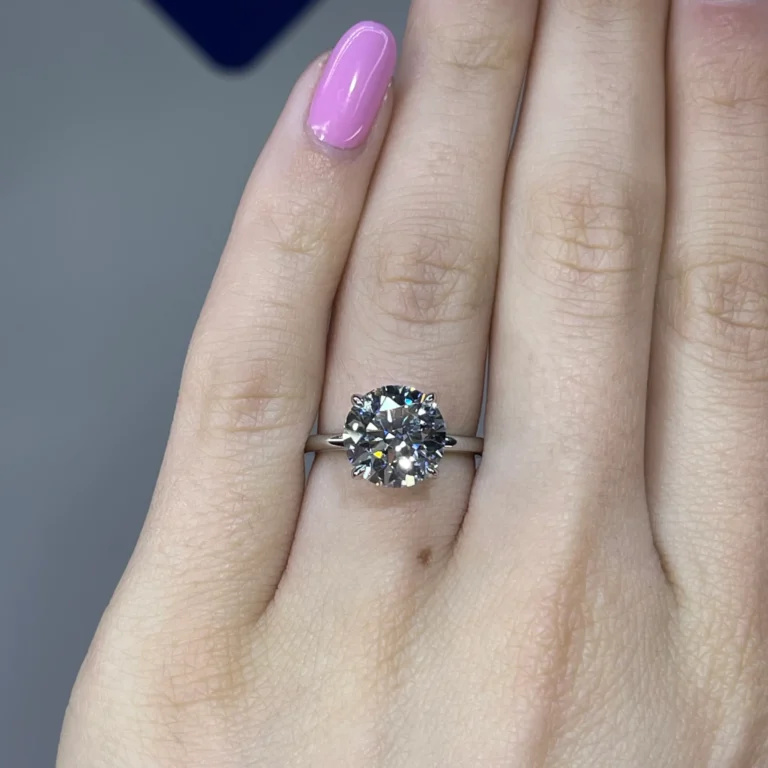
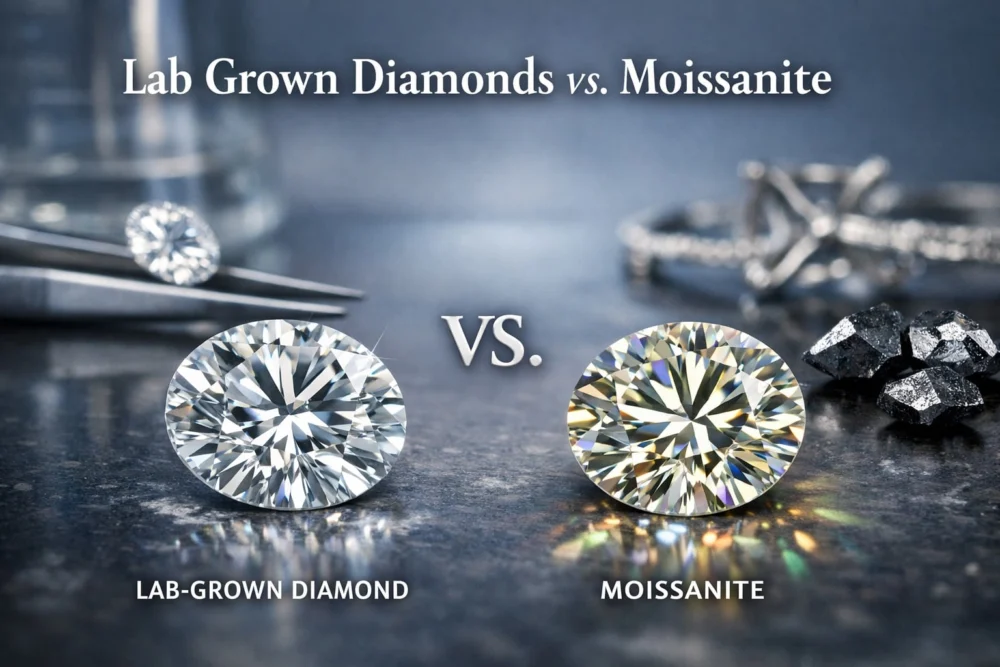
To the untrained eye, a well-cut lab-grown diamond and a moissanite can appear remarkably similar. However, subtle differences emerge upon closer inspection, particularly in how they interact with light.
- Lab-Grown Diamonds: They exhibit a balanced sparkle, characterized by a combination of white brilliance (light reflection) and subtle fire (colored flashes). This classic diamond sparkle is often described as elegant and timeless.
- Moissanite: Due to its higher refractive index and dispersion, moissanite displays more intense and vibrant rainbow-like flashes. This characteristic is often described as "disco ball" or "fiery" and is a prominent feature that differentiates it from diamonds.
The choice between these visual characteristics often comes down to personal preference: the classic, refined sparkle of a diamond versus the more dramatic, colorful brilliance of moissanite.
Refractive Index and Brilliance
The refractive index (RI) is a crucial measure of how a gemstone bends light.
- Lab-Grown Diamonds: Have an RI of approximately 2.42, identical to natural diamonds, contributing to their well-known brilliance and balanced light return.
- Moissanite: Boasts a higher RI (2.65-2.69), which accounts for its exceptional brilliance and pronounced fire. This higher RI means moissanite bends light more significantly, creating a more dazzling effect.
Durability and Hardness
Durability is paramount for jewelry intended for daily wear.

- Lab-Grown Diamonds: With a perfect 10 on the Mohs scale, they are the hardest known natural substance, offering unparalleled resistance to scratches, chipping, and wear.
- Moissanite: Scores 9.25 to 9.5 on the Mohs scale, making it exceptionally durable and suitable for everyday jewelry. While slightly less hard than diamond, it is tougher than most other gemstones, including sapphire and ruby.
Color Qualities
Both lab-grown diamonds and moissanite are available in a spectrum of colors.
- Lab-Grown Diamonds: Are graded using the standard GIA scale (D-Z), with colorless to near-colorless options (D-J) being highly prized for their pure white appearance.
- Moissanite: Is typically described as colorless or near-colorless, with modern production yielding stones that rival the finest colorless diamonds. Some may exhibit subtle undertones under certain lighting conditions.
Price Comparison
Price is a significant differentiator between the two.
- Moissanite: Is considerably more affordable than lab-grown diamonds. A 1-carat moissanite can range from a few hundred dollars to over a thousand, depending on quality and retailer. This makes it an extremely budget-friendly option, especially for larger carat sizes.
- Lab-Grown Diamonds: While less expensive than natural diamonds, they represent a higher investment than moissanite. Prices vary based on the 4Cs, but they offer a genuine diamond experience at a reduced cost.
Making the Final Decision: Which is Right for You?
The choice between lab-grown diamonds and moissanite ultimately depends on individual priorities and preferences.
Moissanite stands out for:

- Maximum Sparkle: Those who desire a gem with exceptional, vibrant rainbow flashes and a lively, eye-catching brilliance.
- Exceptional Value: Buyers seeking the largest possible stone or most intricate designs for a fraction of the cost of diamonds.
- Budget-Conscious Shoppers: Individuals who want a visually stunning gemstone that offers significant savings.
Lab-Grown Diamonds are ideal for:
- Authentic Diamond Experience: Consumers who want a genuine diamond with the exact same physical and chemical properties as a mined diamond, preserving tradition and prestige.
- Timeless Elegance: Those who prefer the classic, crisp white brilliance and subtle sparkle associated with diamonds.
- Guaranteed Durability and Certification: Buyers who value the utmost hardness and the assurance of reputable gemological certifications.
- Ethical and Sustainable Choice: Individuals seeking a diamond that aligns with their values regarding ethical sourcing and environmental impact.
PriceScope: Your Independent Resource for Informed Decisions
Navigating the choices between lab-grown diamonds and moissanite can be complex. PriceScope, as the largest diamond and jewelry forum, serves as an invaluable independent resource. It offers unbiased education, tools for comparing trusted vendors, monthly pricing charts, and active community forums where buyers share real-world experiences.
This platform provides insights into:
- Vendor reliability and diamond quality consistency.
- The visual impact of different color grades and cuts in various lighting conditions.
- Long-term wear experiences with both lab-grown diamonds and moissanite.
- The performance of different settings for each gemstone type.
By leveraging the collective knowledge and resources available at PriceScope, consumers can move beyond marketing claims and make a confident, informed decision that perfectly suits their needs and desires for years to come. Whether the allure of a genuine diamond’s timeless authenticity or the budget-friendly brilliance of moissanite is the ultimate goal, PriceScope empowers you to embark on your jewelry journey with knowledge and certainty.