


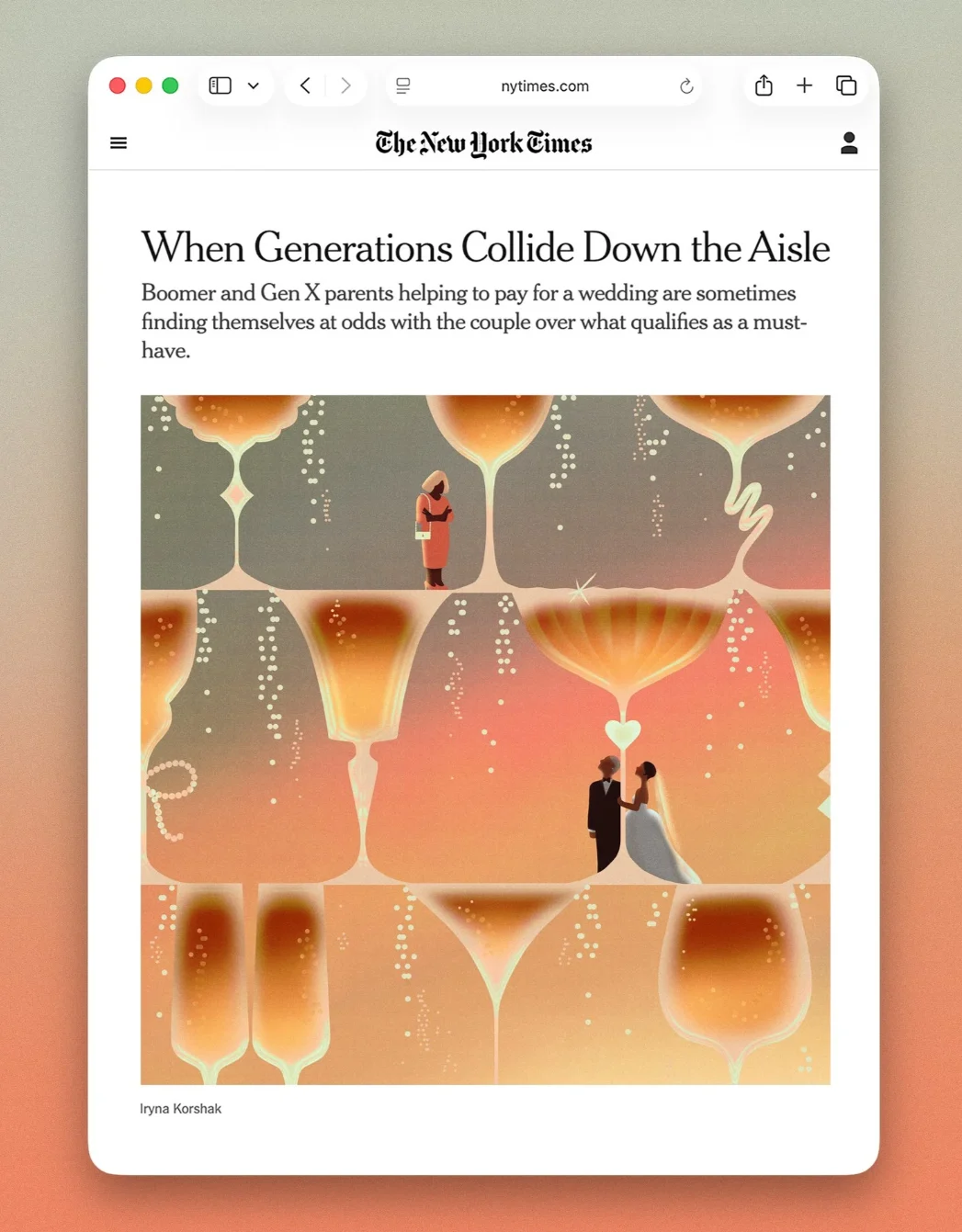
The New York Times piece, published this week, delves into the common scenario where couples, predominantly Millennials and Gen Z, express a desire for weddings that authentically reflect their personalities and values. This often clashes with the expectations of their parents, frequently Gen X or Baby Boomers, who may be contributing significantly to the wedding budget and, in turn, feel entitled to influence decisions towards more conventional aesthetics and protocols. Tammy LaGorce, the reporter for The New York Times, sought expert insight from Offbeat Wed, a platform that has meticulously tracked these evolving dynamics for two decades. Offbeat Wed’s founder, having witnessed the shift from when Gen X planned their weddings to now, as many are becoming parents of marrying children, provided crucial perspective for the article. The feature also spotlighted Ohio-based wedding planner Emily Berg, a member of Offbeat Wed’s vendor community, underscoring the practical realities faced by professionals on the front lines of these family negotiations. This marks the second instance this year that Offbeat Wed’s network has been referenced in The New York Times, signaling a growing recognition of the platform’s unique insights into the nuanced world of modern nuptials.
While the New York Times article adeptly captured the immediate manifestations of this intergenerational conflict, it opened the door for a deeper examination of the underlying systemic factors at play. These factors, crucial for both couples and wedding vendors to comprehend, illuminate why these conflicts are not merely taste disagreements but often complex power negotiations rooted in financial contributions, evolving societal norms, and the pervasive influence of the wedding industrial complex.
The Evolving Landscape of Wedding Celebrations
For generations, weddings have served as pivotal social rites, symbolizing the union of two individuals and often, the merging of two families. Historically, the blueprint for these celebrations was largely dictated by societal customs, religious traditions, and prevailing cultural norms. The mid-to-late 20th century saw the rise of a highly formalized wedding industry that codified many of these traditions, presenting them as aspirational and often non-negotiable standards. Bridesmaids dresses, multi-tiered cakes, grand ballrooms, and elaborate floral arrangements became synonymous with the "dream wedding."
However, the dawn of the 21st century, particularly with the advent of the internet and social media, ushered in a profound shift. Younger generations, exposed to an unprecedented diversity of ideas, cultures, and personal expressions online, began to question and redefine these established norms. The desire for "authenticity" and "personalization" surged, transforming weddings from mere adherence to tradition into bespoke events designed to reflect the unique stories and values of the couple. Pinterest boards, Instagram feeds, and specialized wedding blogs (like Offbeat Wed) became new arbiters of taste, offering a kaleidoscope of unconventional and individualized options, from intimate elopements to themed extravaganzas.
This evolution has created a significant generational chasm. While younger couples embrace innovation and individuality, many parents hold onto the imagery and expectations cultivated during their own formative years—a vision heavily influenced by the mainstream wedding industry of decades past. This clash of visions is not merely aesthetic; it is often deeply intertwined with financial contributions and perceived parental authority.
Financial Contributions and the Weight of Expectation
One of the most potent drivers of intergenerational wedding conflict is the issue of finances. Weddings, by their very nature, are significant investments. According to various industry reports, the average cost of a wedding in the United States has consistently hovered around the $30,000 mark, with many metropolitan areas seeing figures significantly higher. For many couples, particularly those in their 20s or early 30s who may be grappling with student loan debt, housing costs, and career establishment, fully funding such an event independently can be a formidable challenge.
Consequently, parental financial contributions remain a common and often crucial element of wedding budgets. Data from industry surveys frequently indicates that parents contribute a substantial portion, sometimes upwards of 50% or more, to their children’s weddings. While these contributions are often offered out of love and a desire to help, they inherently come with an unspoken, or sometimes explicit, expectation of influence over key decisions. This creates a complex dynamic where financial generosity becomes entangled with desires for control, leading to potential friction when the parents’ vision diverges from that of the couple.
For parents, their financial investment might be seen not just as a gift, but as an opportunity to ensure the wedding aligns with their social standing, family legacy, or personal interpretation of what a "proper" wedding entails. They may feel a responsibility to uphold certain standards, particularly if they are hosting extended family or important social connections. This perspective often clashes with the couple’s desire for financial autonomy to match their creative autonomy, even if the financial burden of such independence is considerable.
The Wedding Industrial Complex: Marketing to Parental Expectations
A critical, yet often under-discussed, aspect of this conflict lies in the strategic marketing practices of the mainstream wedding industry. For decades, the industry has not primarily targeted the marrying couple directly but rather their parents. This approach stems from the understanding that parents are frequently the primary financiers and, crucially, a demographic more susceptible to traditional messaging and authoritative pronouncements about wedding "necessities."
Consider the historical context: In an era before widespread internet access and social media, media authority held immense sway. Bridal magazines, wedding expos, and established vendors were often the sole purveyors of "what a wedding is supposed to look like." This created a powerful narrative that ingrained specific expectations—a grand venue, a lavish meal, a particular type of dress, an extensive guest list—as the benchmarks of a successful and respectable wedding. Parents, having grown up internalizing these messages, often view them as immutable truths rather than commercial constructs.

The modern couple, conversely, has grown up immersed in a digital landscape saturated with diverse opinions, DIY tutorials, and countless alternative options. They are accustomed to critically evaluating information, sifting through contradictory advice, and curating their own aesthetic from a global pool of inspiration. The idea of a venue-mandated coordinator or a traditional florist declaring "YOU NEED THIS" often doesn’t resonate with the same authority it does for their parents.
This divergence in media consumption and perceived authority is central to the conflict. What appears to be a dispute over floral arrangements or guest list size is often, at its core, parents enforcing commercially driven traditions that the couple, informed by a different media ecosystem, simply doesn’t recognize as mandatory. Offbeat Wed’s founder has previously described some of this mainstream wedding marketing as "predatory," arguing that it exploits parental desires for their children’s happiness and social standing by pushing often unnecessary or overly expensive elements as essential. This commercial influence often exacerbates the emotional stakes, turning what could be a collaborative planning process into a battleground for control and differing visions.
Weddings as a "Petri Dish" for Family Dynamics
Beyond financial and commercial influences, weddings inherently act as a concentrated "petri dish" for existing family dynamics. Every simmering issue—how a family handles money, the extent to which adult children are treated as autonomous adults, patterns of communication, and methods of conflict resolution—is amplified and brought to the forefront during the high-stakes, deadline-driven process of wedding planning.
For many couples in their 20s and early 30s, wedding planning represents the first significant life event where they must negotiate complex financial and emotional issues with their parents as fellow adults. This transition from child-parent dynamic to adult-adult negotiation is often fraught with challenges, especially if the family lacks a robust communication infrastructure or established patterns for navigating disagreement respectfully.
The pressure of deadlines, budget constraints, guest list complexities, and the heightened emotional states of everyone involved can quickly transform latent family tensions into overt conflicts. What might seem like a minor disagreement over an appetizer choice can, in reality, be a manifestation of deeper issues around control, trust, or a parent’s difficulty in letting go. These conflicts are remarkably predictable for those who have observed them repeatedly, revealing consistent patterns in how families manage power, boundaries, and individual autonomy.
Understanding this underlying dynamic is invaluable for wedding vendors, who often find themselves caught in the crossfire. When a couple approaches a vendor stressed about a parental conflict, the issue is rarely a simple "taste disagreement." Instead, it is typically a complex power negotiation, a fundamental redefinition of familial roles, playing out in the public arena of a wedding. Recognizing this shifts a vendor’s role from merely executing a service to potentially serving as a mediator, an empathetic listener, and a strategic advisor, capable of helping clients navigate these intricate family landscapes.
The New York Times’ Growing Interest in Nuance
The repeated engagement of The New York Times with Offbeat Wed and its community underscores a broader trend in mainstream media: a growing appetite for nuanced, authentic, and culturally relevant narratives about weddings. For too long, wedding coverage in major publications often adhered to a singular, aspirational vision, neglecting the diverse realities and inherent complexities faced by modern couples.
Offbeat Wed, launched in 2007, positioned itself early on as a counter-narrative to this mainstream portrayal. By championing "offbeat" and non-traditional weddings, it created a platform for stories that celebrated individuality, challenged commercial pressures, and openly discussed the often-messy realities of wedding planning. This long-standing commitment to exploring the deeper societal and familial implications of weddings has made it an indispensable resource for journalists like Tammy LaGorce. When reporters seek sources capable of offering a comprehensive, long-view perspective on evolving trends, especially those touching on intergenerational shifts, platforms with a proven track record of critical observation become vital.
Furthermore, Offbeat Wed’s robust vendor community provides The New York Times with access to professionals who are directly experiencing these dynamics. These vendors, often specializing in non-traditional events, possess unique insights into how couples are navigating family pressures, budget constraints, and the desire for authenticity. Their "trenches-level" reports offer invaluable real-world validation and examples for journalistic pieces. This symbiotic relationship between niche communities and mainstream media signals a maturation in how weddings are understood and reported, moving beyond superficial aesthetics to address the profound human experiences they encapsulate.
Implications for Couples, Families, and the Wedding Industry
The ongoing tension between traditional expectations and personal desires in wedding planning carries significant implications across the board:
- For Couples: Navigating these conflicts can be emotionally taxing, requiring couples to develop strong communication skills, establish clear boundaries with parents, and often make difficult compromises. It can also be an unexpected catalyst for personal growth, forcing couples to define their values and stand firm in their decisions. The financial freedom to plan a wedding without parental input often comes at the cost of a smaller, more intimate event, highlighting the difficult choices many face.
- For Families: The wedding planning period can either strengthen family bonds through open communication and mutual respect or exacerbate existing fractures. It presents a crucial opportunity for parents to acknowledge their adult children’s autonomy and for adult children to articulate their boundaries respectfully. Successfully navigating this period can lay a foundation for healthier adult relationships; conversely, unresolved conflicts can leave lasting scars.
- For Wedding Vendors: The insights gained from understanding these intergenerational dynamics are paramount for vendors, particularly those catering to the "offbeat" market. It necessitates moving beyond simply executing a service to becoming a strategic partner and empathetic advisor. Vendors must learn to actively listen, ask probing questions that uncover underlying family tensions, and offer solutions that respect both the couple’s vision and the family’s complex relationships. This requires a nuanced approach, prioritizing client well-being over simply selling services, and recognizing that they are often facilitating a crucial rite of passage not just for the couple, but for the entire family unit. The ability to navigate these dynamics effectively can differentiate a vendor in an increasingly competitive market.
In conclusion, the modern wedding is far more than a celebration; it is a microcosm of evolving societal norms, generational shifts, and intricate family dynamics. The New York Times’ recent focus on intergenerational wedding conflict, informed by the two decades of observation from platforms like Offbeat Wed, serves as a powerful reminder that these celebrations are deeply personal, financially significant, and emotionally charged events. As younger generations continue to redefine tradition, and as the wedding industry adapts to these shifts, a deeper understanding of the underlying power dynamics, commercial influences, and family relationships will be essential for creating truly meaningful and harmonious celebrations for all involved. The conversation sparked by these articles is not just about wedding planning; it’s about how families evolve, communicate, and celebrate in a rapidly changing world.